
6 October Bridge, Egypt
The Sixth of October Bridge in Egypt is an incredible bridge, so long that it crosses the same river twice.
It took three decades to build, but cost a local government the equivalent of just £3 million.
The 6th of October bridge was first conceived in 1969 by Egyptian president Gamal Abdel-Nasser, who sought to transform Cairo’s city streets, which were at the time overwhelmed by a surge in traffic.
Approximately 65,000 cars, buses and motorcycles were traversing city streets in the capital, each one forced into small and poorly equipped highways, with the issue only expected to get worse.
The new bridge was designed to connect the city by joining the banks of the massive, world-famous, River Nile. By the end of its eighth-phase, spanning a nearly 30-year construction period, the completed bridge crossed the river twice in two places.
The bridge provides stunning views of the River Nile. The Arab Contractors firm started the construction in mid-1969 and finished the structure in 1996 – taking a grand total of 27 years to complete.
The especially lengthy building period was due to the economic downturn experienced in Egypt following a series of conflicts in which the country was involved in the late 20th century.
Nevertheless, Cairo was able to shell out approximately EGP200 million (£3.3 million) to build a massive 22km (13.6 mile) structure that snaked through the city.
The finished product crossed the Nile at two points – Downtown Cairo and Mohandiseen – while reaching across the Nile island of Gezira.
Cairo has a dense traffic structure that the bridge partially resolves. The bridge was named so to commemorate the date the Egyptian army crossed the Suez Canal to start the 1973 Arab–Israeli Yom Kippur War.
The project was hailed as a national endeavour and built to include an observatory that would allow locals to look out onto the Nile and the city’s many landmarks beyond.
Those who cross the bridge today can spot the famed Egyptian Museum, Cairo Tower, and the Maspero television building during their short trip across the Nile banks.
The final bridge is the longest in Egypt, and while it is primarily used to alleviate traffic congestion, visitors have recommended walking across to take in its views.
…….
Elmina Castle
Elmina Castle, a well fortified castle in Elmina, Ghana, which is the oldest surviving European building in Africa south of the Sahara,was built in 1482 by the Portuguese as a major centre of the transatlantic slave trade.
The Portuguese had begun exploring the West African coast for both trading and Christian missionary purposes in the 15th century. In 1471 they arrived at what was later called the Gold Coast, finding a thriving gold trading economy. They established their own trading outpost, which was subsequently called Elmina, from the Portuguese De Costa da el Mina de Ouro (the Coast of Gold Mines). There they established a friendly and profitable relationship with a powerful local chief they called Caramansa.
In 1482 Caramansa was persuaded to permit the Portuguese to build a fort commanding the harbour to protect the gold trade. The castle, originally known as Castelo de São Jorge da Mina, or St. George of the Mine Castle, was constructed from numbered, prefabricated, granite blocks that were shipped out from Portugal in a fleet of 11 or 12 ships together with 700 soldiers for the garrison.Many accounts maintain that one of those on the expedition was Christopher Columbus, 10 years before he set sail on his voyage to America.
Elmina later became the centre of Portuguese trade in slaves. The castle became a depot from which enslaved Africans from the interior were sold and shipped to Brazil and other Portuguese colonies.
In the 16th century, the Dutch, the British, and the French took an increasing interest in the West African coast, and the Dutch attacked Elmina several times. In 1637 they successfully bombarded the castle into submission, and Elmina then became the main Dutch Gold Coast centre.The Dutch greatly enlarged and strengthened the castle in the 1770s, and they converted the chapel for use in staging slave auctions. The dungeons, where as many as 200 slaves at a time were held before shipment, can still be seen.
The Middle Passage
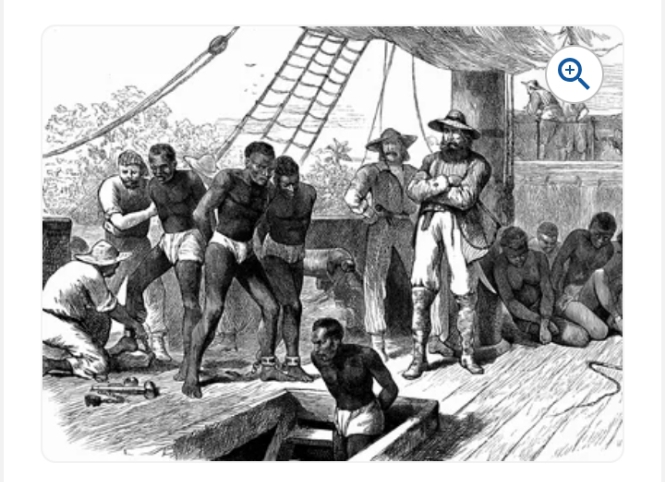
Transporting enslaved Africans usually to Brazil or an island in the Caribbean, was notorious for its brutality and for the overcrowded unsanitary conditions on slave ships, in which hundreds of Africans were packed tightly into tiers below decks for a voyage of about 5,000 miles (8,000 km) that could last from a few weeks to several months.
Candles could not burn
The enslave Africans were typically chained together, and usually the low ceilings did not permit them to sit upright. The heat was intolerable, and the oxygen levels became so low that candles would not burn.
Sexual Abuse
Atrocities and sexual abuse of the enslaved captives were widespread, although their monetary value as slaves perhaps mitigated such treatment.
In all, Elmina castle is where enslaved Africans were chained and shipped through the port of no return to the Americas in subhuman condition.
Captive Africans being moved to a ship from Elmina Castle for 8000 miles of transAtlantic journey to Americas.