
China says it’s ready to fight ‘any type of war’ with USA
By Uji A. ILIYASU
China has warned the US it is ready to fight “any type” of war after hitting back at President Donald Trump’s mounting trade tariffs.
The world’s top two economies have edged closer to a trade war after Trump slapped more tariffs on all Chinese goods. China quickly retaliated imposing 10-15% tariffs on US farm products.
“If war is what the US wants, be it a tariff war, a trade war or any other type of war, we’re ready to fight till the end,” China’s embassy said on X, reposting a line from a government statement on Tuesday.
It is some of the strongest rhetoric so far from China since Trump became president and comes as leaders gathered in Beijing for the annual National People’s Congress.
On Wednesday, China’s Premier Li Qiang announced that China would again boost its defence spending by 7.2% this year and warned that “changes unseen in a century were unfolding across the world at a faster pace.” This increase was expected and matches the figure announced last year.
Leaders in Beijing are trying to send a message to people in China that they are confident the country’s economy can grow, even with the threat of a trade war.
China has been keen to portray an image of being a stable, peaceful country in contrast to the US, which Beijing accuses of being embroiled in wars in the Middle East and Ukraine.
China may also hope to capitalise on Trump’s actions relating to US allies such as Canada and Mexico, which have also been hit by tariffs, and will not want to ramp up the rhetoric too far to scare off potential new global partners.
The Premier’s speech in Beijing on Wednesday emphasised that China would continue to open up and hoped to attract more foreign investments.
China has, in the past emphasised that it is ready to go to war. Last October, President Xi called for troops to strengthen their preparedness for war as they held military drills around the self-governing island of Taiwan. But there is a difference between military preparedness and a readiness to go to war.
Beijing is to increase military spending by more than 7 per cent this year
The Chinese embassy in Washington quoted a foreign ministry statement in English from the previous day, which also accused the US of blaming China for the influx of the drug fentanyl.
“The fentanyl issue is a flimsy excuse to raise US tariffs on Chinese imports,” the foreign ministry spokesperson said.
“Intimidation does not scare us. Bullying does not work on us. Pressuring, coercion or threats are not the right way of dealing with China,” he added.
The US-China relationship is always one of the most contentious in the world. This post on X has been widely shared and could be used by the China hawks in Trump’s cabinet as evidence that Beijing is Washington’s biggest foreign policy and economic threat.
Officials in Beijing had been hopeful that US–China relations under Trump could get off to a more cordial start after he invited Xi to his inauguration. Trump also said the two leaders had “a great phone call” just a few days before he entered the White House.
There were reports that the two leaders were due to have another call last month. That did not happen.
Xi had already been battling persistently low consumption, a property crisis and unemployment.
China has pledged to pump billions of dollars into its ailing economy and its leaders unveiled the plan as thousands of delegates attend the National People’s Congress, a rubber-stamp parliament, which passes decisions already made behind closed doors.
China has the world’s second-largest military budget at $245bn but it is far smaller than that of the US. Beijing spends 1.6 per cent of GDP on its military, far less than the US or Russia, according to the Stockholm International Peace Research Institute.
However, analysts believe China downplays how much it spends on defence.
How Trump sparked the tariff war
The US-China trade war was sparked by President Donald Trump’s administration in 2018, with the imposition of tariffs on Chinese goods. The initial tariffs targeted Chinese products worth $50 billion, which led to China retaliating with tariffs on US agricultural goods, such as soybeans, wheat, and corn.
The trade tensions escalated over the years, with both countries imposing additional tariffs on each other’s goods. The US accused China of unfair trade practices, including intellectual property theft and forced technology transfer, while China argued that the US was trying to stifle its economic growth and development.
Key events in the US-China tariff war
In March 2018, Trump announces tariffs on Chinese steel and aluminum imports;
in April 2018, China retaliates with tariffs on US agricultural goods;
in May 2019, the US increased tariffs on Chinese goods from 10 per cent to 25 per cent; in January 2020, the US and China sign a phase-one trade deal, which includes provisions for China to increase purchases of US goods and strengthen intellectual property protections.
The trade war has had significant implications for the global economy, including increased costs for businesses and consumers, disrupted supply chains, and decreased economic growth.
US-China 2nd tariff war
Donald Trump’s second presidency in 2025 marked the beginning of a new tariff war. On March 4, 2025, Trump imposed 25 per cent tariffs on most Canadian and Mexican imports, and raised the tariff on Chinese imports to 20 per cent. This move sparked immediate retaliation from Canada and China, with Canada imposing phased levies on $107 billion worth of US goods and China imposing tariffs of up to 15 per cent on US goods, mainly targeting American agricultural shipments.
Trump’s decision to impose tariffs was aimed at protecting America’s steel and aluminum industries, which he believed were being harmed by unfair trade practices and global excess capacity. The tariffs were also intended to generate revenue and create domestic manufacturing jobs.
Implications on global economy
The tariff war has significant implications for the global economy, including increased costs for businesses and consumers, disrupted supply chains, and decreased economic growth. The move has also been criticized by other countries, with the European Commission spokesman, Olof Gill, stating that the tariffs threaten to disrupt global trade and hurt economic partners.
Trump’s war destined to fail
Trump’s trade war against China is destined to fail because Washington cannot dictate terms to China because Chinese economy is too diversified to be affected by adversity in few sectors.
It is worthy of note that China’s exports rose 7.1 per cent to $3.5 trillion in 2024 with the US accounting for just $524.6 billion, per the General Administration of Customs; the share of Global South countries and regions in China’s exports ($1.67 trillion) has surpassed that of the top industrialised nations ($1.4 trillion);
gobal South countries and regions account for nearly half of its total trade volume, or $2.8 trillion: China trades with 150+ economies, and it’s total goods trade grew 5% year-on-year to $6.1 trillion in 2024. Also ASEAN has remained Beijing’s largest trade partner for five consecutive years.
In all, conflict between two nuclear powers, such as the United States and China, would have catastrophic consequences for the world. The implications of such a conflict would be far-reaching and devastating, affecting not only the two nations involved but also the global community.
Source: GeopoliticsLive

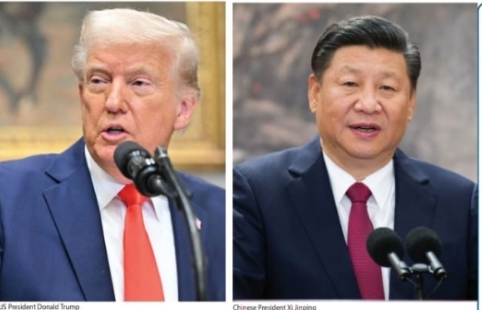
US President Donald Trump
Chinese President Xi Jinping