
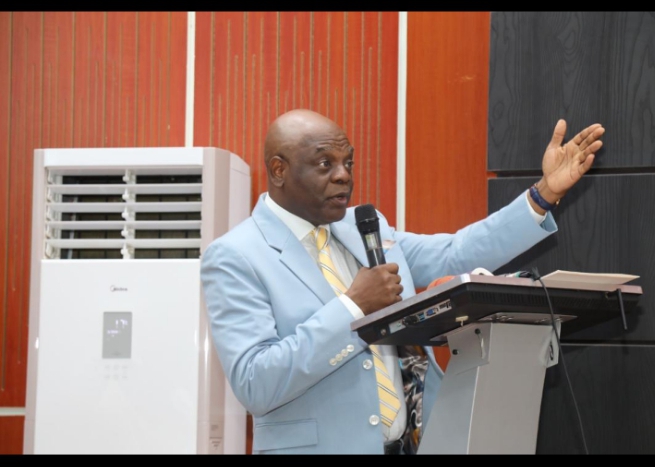
TETFund chief jurges tertiary institutions to embrace technology or risk wasting billions in ICT investment
By Uji A Iliyasu, Abuja
The Executive Secretary of the Tertiary Education Trust Fund (TETFund), Sonny Echono, has urged Nigerian tertiary institutions to urgently embrace technology in teaching, research, and administration, warning that billions of naira invested in ICT infrastructure risk being wasted through underutilisation.
Echono made the call in Abuja on Monday while delivering remarks at a two-day workshop on the adoption and usage of Blackboard and the Tertiary Education, Research, Applications and Services (TERAS) platform. The workshop, organised by TETFund, drew registrars, bursars, directors of academic planning and ICT, as well as thesis repository managers from beneficiary institutions.
He lamented that despite TETFund’s early investments in digital learning platforms such as TERAS, many universities, polytechnics and colleges of education remain slow in adopting ICT tools. According to him, Nigeria’s growing population and shortage of physical classrooms make technology the only viable pathway to expanding access to quality education.
“We are no longer confined to the four walls of classrooms. With just an Android phone or a digital device, students should be able to access content, participate in learning, and acquire skills. There is no alternative to technology if we must prepare our youths for the opportunities ahead,” Echono stressed.
The TETFund boss decried the slow pace of digital transition in several institutions, noting that some still send hard-copy requests to the Fund despite directives for electronic submissions. He described the online presence of many institutions as “embarrassingly outdated,” insisting that functional and regularly updated websites should be a minimum requirement in the digital age.
Citing the successes recorded during the COVID-19 lockdown, when TETFund partnered state governments, the Nigeria Television Authority (NTA) and radio stations to deliver WAEC syllabus-based lessons, Echono recalled that the period produced one of Nigeria’s best WAEC results, underscoring the transformative potential of technology.
He expressed concern that Nigeria ranks 189th globally and 25th in Africa in education competitiveness, trailing smaller nations such as Rwanda and Mauritius which have leveraged ICT to overhaul their systems.
“Government has done its part by providing the infrastructure. But when equipment is procured and platforms created and they are not being used, that is the very definition of waste,” he warned.
Echono urged heads of tertiary institutions to drive the adoption of digital platforms like TERAS among lecturers and students, noting that going forward, more than half of TETFund’s education investments would be channelled into ICT rather than physical infrastructure. He further linked Nigeria’s underdevelopment to its failure to harness technology in key sectors such as oil, agriculture, and manufacturing, contrasting the situation with China’s rapid transformation through deliberate investment in knowledge and innovation.
“We can do the same if we decide to do the right thing. The right thing starts with our education system. The building block of every nation is knowledge,” he added.
Earlier, TETFund’s Director of ICT, Mr Joseph Odo, explained that the interactive sessions at the workshop were designed to deepen understanding of the Fund’s digital platforms and to foster collaboration among beneficiary institutions.
“This is part of our engagement with key stakeholders—registrars, librarians, ICT directors, repository managers and academic planners—to ensure that everyone understands the interventions we are providing. The world is moving fast technology-wise, and we cannot afford to be left behind,” Odo said.
He disclosed that the sessions, which will hold across all six geopolitical zones, aim to strengthen the utilisation of TETFund-funded digital platforms, which aggregate data for planning and improve teaching, research and learning outcomes. He added that TERAS is evolving into “an educational lifestyle” that supports students, lecturers, administrators and government planners.