

Gov Aliyu: The soul of Sokoto’s renewal agenda
By Lawal Jet Kaugama
When history eventually turns its luminous gaze upon Sokoto State, Ahmed Aliyu will not merely appear in the record of governors, it will be engraved in the hearts of the people. In a time when many public officials treat governance as theatre and politics as commerce, Gov Aliyu has quietly, steadily, and resolutely demonstrated that leadership is about impact, not applause.
The recent commissioning of the ₦4.1 billion, 14.4-km Buzulega–Lukuyawa–Yar Gada–Tabanni–Malikawa–Shalla–Kware road speaks volumes about his approach to governance. This is not just a ribbon-cutting ceremony; it is the story of a leader’s sincerity, a government’s responsiveness, and a people’s hope made visible in asphalt and tar.
The project, jointly funded by the Sokoto State Government, the World Bank, and the Central Bank of Nigeria (CBN), is more than an engineering feat, it is a metaphor for partnership, progress, and promise.
By connecting seven rural communities across three local government areas, Kware, Gwadabawa, and Wurno, the project reflects Gov Aliyu’s deliberate policy to link isolation with inclusion, and poverty with productivity.
For many ordinary citizens of Sokoto, Gov Aliyu represents a refreshing break from the past, a governor who listens, acts, and delivers without fanfare. In the villages his roads touch, in the hospitals his administration renovates, and in the schools he equips, people see more than governance; they see care. And that is why they hold him dear.
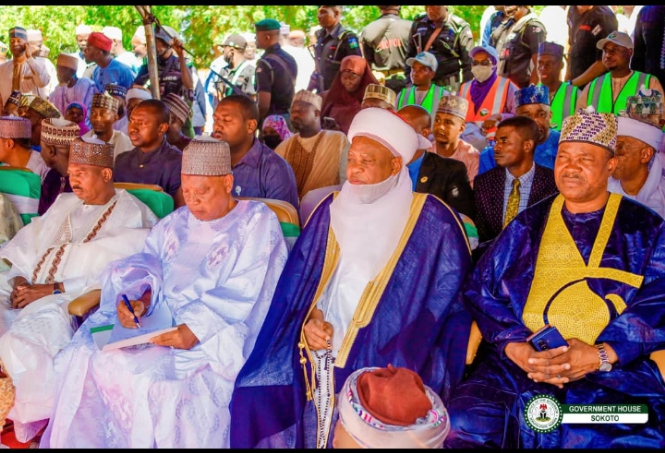
When the Sultan of Sokoto, His Eminence Muhammad Sa’ad Abubakar, openly commends a sitting governor, it is not mere courtesy but a testimony.
“The Governor is doing well,” the Sultan said, urging other politicians to emulate him. Coming from the revered custodian of Sokoto’s moral compass, this is no small praise.
Aliyu’s humility, too, endears him to the people. Unlike many who mount the saddle of power only to be blinded by its glitter, he has kept his gaze firmly on the people’s needs. Whether it is in agriculture, education, or infrastructure, his policies are people-centred and data-driven.
Gov Aliyu’s brand of leadership is one rooted in empathy and execution. When he says something, he does it.
Former Military Administrator of Sokoto State, Navy Captain Abdulrasheed Adisa Raji (rtd), captured it aptly when he said, “The completion of this road clearly demonstrates how Governor Aliyu is matching words with action.”
This simple sentence sums up the man. Aliyu does not make promises for headlines, he makes them for history. His governance style recalls the old, dignified tradition of public service, where projects are not political trophies but public trusts.
Buzulega–Lukuyawa–Yar Gada–Tabanni–Malikawa–Shalla–Kware road, initially designed as a feeder route but transformed into a fully tarred road under his directive, epitomizes this philosophy. It signals a governor who does not settle for mediocrity.
Sokoto, with its largely agrarian population, depends heavily on rural connectivity. Roads are the lifelines of its economy. They determine how fast a farmer can move his onions or rice to market, how quickly a mother can reach a health centre, or how easily a student can travel to school.
Aliyu understands this intimately. That is why rural infrastructure sits at the heart of his development agenda. He sees roads not merely as physical structures but as economic arteries that nourish the state’s social and commercial organs. The partnership with the World Bank and CBN under the Rural Agricultural and Marketing Project (RAMM) reflects his ability to blend local vision with global collaboration, which is a hallmark of modern governance.
Beyond roads, Alyu’s administration’s investments in agricultural modernization and post-harvest storage facilities are reshaping Sokoto’s rural economy. The Governor’s call for farmers to “take ownership of the project and protect it against vandalism” is not just a warning, it is an invitation to civic responsibility, a call for partnership between government and the governed.
In an era where politics is often reduced to self-promotion and social media noise, Aliyu’s calm, almost understated style stands out. He lets his work speak. There is a quiet confidence about him, a sense of purpose that does not need a microphone to be felt.
His special adviser on rural roads, Malami Muhammad Galadanci, noted that all residents whose farmlands were affected by the project were duly compensated. This attention to fairness underscores the governor’s belief that progress must be inclusive, not exploitative.
Leadership, it is often said, is not about how many years one spends in power but how many lives one touches in those years. By that measure, Gov Aliyu’s scorecard glows.
He has not only built roads but also built trust. He has not only improved transport but also restored faith in government’s ability to work for the people. From the majority leader of the Sokoto State House of Assembly to the chairmen of the benefiting local governments, one refrain echoes: gratitude.
For the farmers whose produce will now reach markets faster, for the traders whose goods will travel farther, and for the schoolchildren whose daily journeys have been made safer, Ahmed Aliyu is more than a governor; he is a benefactor, a reformer, and, above all, a believer in Sokoto’s boundless potential.
Governor Ahmed Aliyu’s story is still unfolding, but its themes are already clear: humility, service, and transformation. His administration’s projects do not merely beautify Sokoto—they bind its people together in shared progress.
In an age when cynicism about politics runs deep, he reminds us that good governance is still possible, that sincerity still matters, and that leadership, at its best, is an act of love.
Lawal Jet Kaugama, a commentator on national issues, writes from kano