
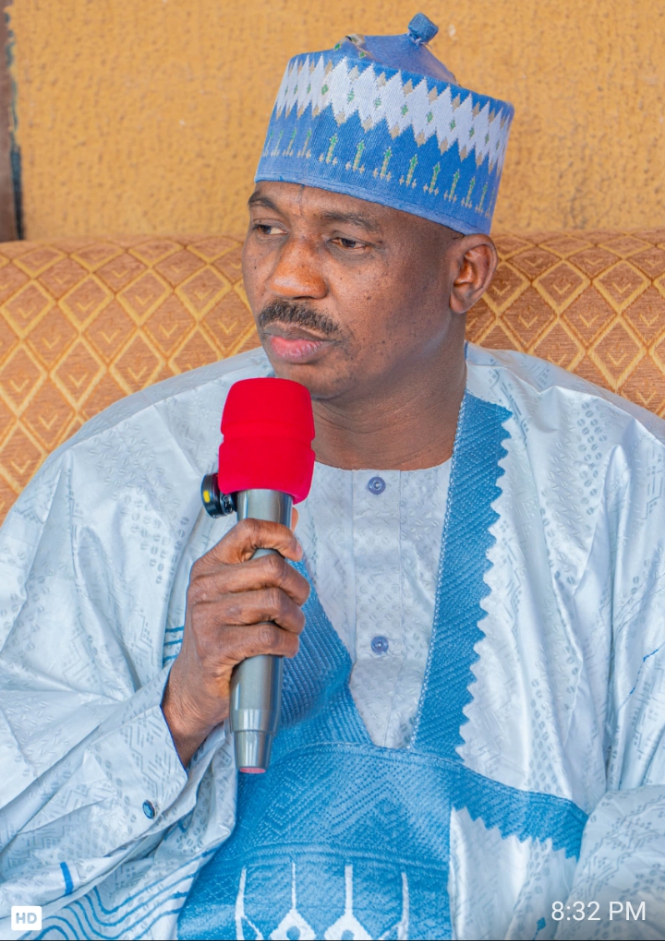
Gov. Aliyu and the quiet power of humane leadership
By Lawal Jet Kaugama
At a time when political leadership is often measured by loud declarations, partisan alignments, and rigid loyalties, the conduct of Sokoto State Governor, Ahmed Aliyu, continues to present a refreshing contrast. His condolence visit to the family of the late Village Head of Gada, Alhaji Ibrahim Isah, is more than a ceremonial obligation; it is a clear reflection of a leader who understands that governance, at its core, is about people, compassion, and shared humanity.
The death of a traditional ruler is always a painful moment for any community. Such figures often serve not only as custodians of culture and tradition but also as mediators, moral guides, and symbols of unity. Governor Aliyu’s decision to personally console the Gada community underscores his appreciation of these grassroots institutions and the human bonds that hold society together. It sends a strong message that leadership does not begin and end in government offices but must be felt in homes, villages, and hearts.
By describing the late Alhaji Ibrahim Isah as pious, humble, honest, and God-fearing, the Governor did more than eulogise a respected leader; he affirmed the values that sustain peaceful coexistence. These qualities transcend political affiliation, ethnic background, or personal interest. They are universal virtues, respected by people of all faiths and persuasions. In acknowledging them publicly, Governor Aliyu aligned himself with moral leadership rather than narrow political calculation.
What stands out most in this gesture is the Governor’s consistent ability to relate with people at all levels of society. From traditional rulers and community elders to ordinary citizens, his interactions reveal a leader who does not discriminate based on political loyalty or religious leaning. In a diverse state like Sokoto, where unity is essential for progress, such an approach is not only admirable but necessary. It fosters trust, reduces tension, and strengthens the social fabric.
Governor Aliyu’s prayer for the forgiveness of the deceased and his request for comfort for the family further highlight the depth of his humanity. Leadership, especially in moments of grief, demands empathy. It requires the ability to step beyond policy debates and political differences to acknowledge shared human vulnerability. By doing so, the Governor demonstrated that he sees the people not merely as constituents but as fellow human beings deserving of care and respect.
The response from the family, delivered by Ambassador Sahabi Isa Gada, also speaks volumes. Their appreciation of the Governor’s visit and their prayers for his leadership indicate a relationship built on sincerity rather than obligation. When people genuinely commend a leader, it is often because they have felt the impact of his actions, not just his words. The acknowledgment of ongoing people-oriented projects across the state, including in Gada Local Government Area, reinforces the perception of a government that strives to be inclusive in development.
Importantly, Governor Aliyu’s governance style shows that compassion and performance are not mutually exclusive. While he is visible in moments of sorrow, he is equally committed to initiatives that improve livelihoods, infrastructure, and social welfare. This balance strengthens his bond with the people, as they see a leader who is present both in times of need and in the pursuit of long-term progress.
Another defining feature of Governor Aliyu’s leadership is his respect for tradition and community structures without politicising them. Traditional institutions remain neutral spaces meant to unite rather than divide. By honouring the late Village Head of Gada without injecting partisan undertones, the Governor preserved the sanctity of that institution. This restraint reflects maturity and an understanding of the delicate role such leaders play in maintaining harmony.
Furthermore, the special prayers offered for the repose of the late Village Head’s soul and for sustained peace in Sokoto State capture the broader vision of Governor Aliyu’s administration. Peaceful coexistence is not achieved through force alone but through mutual respect, dialogue, and shared values. By consistently promoting peace in word and action, the Governor reinforces a culture of tolerance and unity.
In all, Governor Ahmed Aliyu’s condolence visit to Gada is a powerful reminder that true leadership is rooted in humanity. His ability to connect with people across social, religious, and political lines reflects a governing philosophy anchored in empathy, inclusiveness, and service. In a time when many leaders are judged by political loyalty tests, Governor Aliyu stands out as one who prioritises the common good. His actions affirm that leadership, when guided by compassion and respect, leaves a lasting impact far beyond the tenure of office.
Lawal Jet Kaugama, a commentator on national issues, writes from Kano