
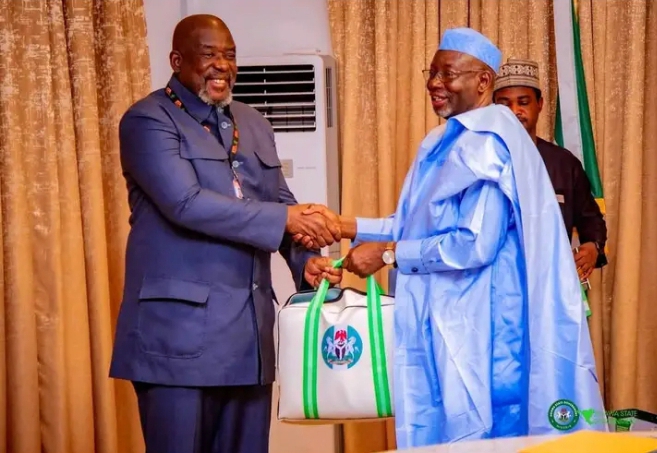
Gov Umar Namadi building industrial base for Jigawa State
By Lawal Jet Kaugama
Governor Malam Umar Namadi’s engagement with the International Institute of Tropical Agriculture (IITA) is more than a routine courtesy call; it is a reflection of a broader, deliberate vision for agricultural transformation in Jigawa State and Nigeria at large. At a time when agriculture remains central to food security, employment, and economic stability, Governor Namadi’s leadership underscores how subnational governments can play a pivotal role in repositioning the sector for sustainable growth.
Jigawa State has long been recognized as an agrarian society, with a majority of its population dependent on farming and related activities for their livelihoods. However, like many states across Nigeria, Jigawa has faced persistent challenges: low productivity, dependence on rain-fed agriculture, limited access to improved seeds and technology, post-harvest losses, and the vulnerability of farmers to climate change. Governor Namadi’s approach to governance places these realities at the center of policy-making, recognizing that agriculture is not merely a traditional occupation but a strategic economic sector that can drive inclusive development.
The governor’s commitment to partnering with IITA, one of Africa’s foremost agricultural research institutions, is a strong signal of his belief in evidence-based development. By seeking collaboration with a globally respected institute known for innovations in crop improvement, soil health, pest management, and agribusiness development, Governor Namadi demonstrates an understanding that modern agriculture must be knowledge-driven. Such partnerships bridge the gap between research and practice, ensuring that farmers benefit directly from scientific advancements rather than remaining disconnected from them.
Governor Namadi’s contributions to agriculture are also evident in his emphasis on sustainability. Agriculture in northern Nigeria is increasingly threatened by climate variability, desertification, and resource depletion. By welcoming IITA’s expertise in sustainable agricultural practices, the governor shows foresight in prioritizing long-term resilience over short-term gains. Sustainable farming methods not only protect the environment but also stabilize yields, improve soil fertility, and reduce farmers’ vulnerability to shocks. This approach aligns Jigawa State with global best practices while addressing local realities.
Beyond sustainability, the governor’s agricultural vision is deeply rooted in improving the livelihoods of farmers. His administration recognizes that agricultural transformation must translate into tangible benefits for rural communities—higher incomes, food security, and dignity of labor. By supporting initiatives that enhance productivity and value addition, Governor Namadi is helping to move agriculture from subsistence to a more commercial and profitable enterprise. This shift is crucial for retaining young people in agriculture and curbing rural-urban migration, which has become a pressing social challenge in Nigeria.
At the national level, Governor Namadi’s efforts contribute to Nigeria’s broader agricultural objectives. Nigeria’s quest for food self-sufficiency and reduced reliance on imports cannot be achieved by the federal government alone. It requires proactive state governments that are willing to invest, innovate, and collaborate. Jigawa State’s partnership with IITA positions it as a model for how states can leverage international expertise to strengthen local agricultural systems. In doing so, the state contributes to national food security and economic diversification.
Furthermore, Governor Namadi’s leadership style reflects an appreciation for partnership and inclusivity. Agriculture is a complex sector that involves multiple stakeholders—research institutions, development partners, farmers, private sector actors, and government agencies. By fostering collaboration rather than working in isolation, the governor creates an enabling environment for coordinated action. This inclusive approach increases the likelihood that agricultural interventions will be effective, scalable, and sustainable.
Another notable aspect of Governor Namadi’s contribution is his focus on institutional strengthening. Sustainable agricultural development requires strong systems: extension services that reach farmers, policies that encourage investment, and institutions that can implement programs efficiently. Engagements with organizations like IITA help build local capacity, transfer skills, and strengthen state institutions. Over time, this institutional development ensures that progress in agriculture is not dependent on personalities but embedded within governance structures.
Governor Namadi’s agricultural agenda also carries symbolic importance. By publicly prioritizing agriculture and personally engaging with development partners, he sends a clear message that farming matters. This symbolism is powerful in a country where agriculture is sometimes overshadowed by the oil sector. It restores pride in farming and reinforces its role as a cornerstone of economic and social development.
In conclusion, Governor Malam Umar Namadi’s contributions to agriculture in Jigawa State and Nigeria reflect strategic thinking, commitment to sustainability, and a genuine concern for the welfare of farmers. His partnership with IITA exemplifies how visionary leadership can harness research, innovation, and collaboration to drive meaningful change. As Nigeria continues to grapple with food security and rural development challenges, leaders like Governor Namadi demonstrate that agriculture, when treated as a priority sector, can be a powerful engine for growth, resilience, and shared prosperity.
Lawal Jet Kaugama, a commentator on national issues, writes from Kano