
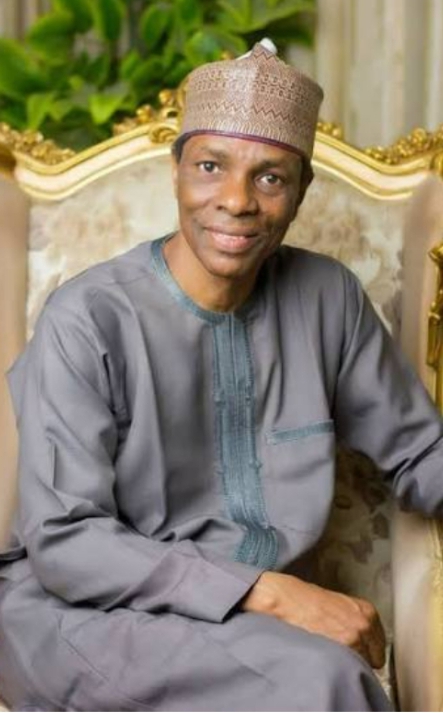
Barr. Mukhtar Shagari and the substance of public service
By Lawal Jet Kaugama
As public office comes to an end, so too, for many, does public spiritedness. It is a familiar Nigerian story: officials who commanded attention and resources in government quietly recede from view once the trappings of office are gone, their commitment to national development apparently tied to the privileges of a title rather than to the people they once swore to serve.
Against this backdrop, the recent appearance of former Minister of Water Resources, Barr. Mukhtar Shagari, at the flag-off of the ₦5.33bn Dange-Fajaldu road project in Sokoto State offers an instructive counter-example, and one worth examining closely.
Barr. Shagari’s presence at the ceremony, at the invitation of Governor Ahmad Aliyu, was beyond a courtesy appearance.
As chairman of the governing board of the Nigeria Inland Waterway Authority (NIWA), he brought both institutional weight and technical perspective to an event that might otherwise have passed as routine political theatre. His remarks, tying the 7.5km road project to broader questions of security, agricultural productivity, and rural livelihoods, revealed a continued and evidently genuine engagement with the practical realities of governance long after leaving ministerial office.
This matters because the road itself, though modest in length, sits at the intersection of several pressing national concerns. Rural roads are not merely matters of convenience; they are the arteries through which food security, commerce, and emergency services flow.
Barr. Shagari’s observation that quality road infrastructure enhances security operations and enables the rapid deployment of personnel during emergencies is not a throwaway line.
In this country insecurity in rural areas has too often been exacerbated by poor access routes that hamper both prevention and response. This point deserves more attention than it typically receives in public discourse. It is to Shagari’s credit that he foregrounded it.
Equally noteworthy is his call for the contractor to adhere strictly to specifications and timelines, paired with an appeal to host communities to protect the road once completed. This is the language of someone who understands that infrastructure projects in Nigeria too often fail not at the point of commissioning but in the years after, when poor maintenance culture and weak community ownership allow hard-won gains to erode.
A former minister who continues to model this kind of stewardship-minded thinking, rather than simply cutting ribbons and departing, sets a standard that many of his peers in public life would do well to emulate.
There is also something to be said for the collaborative spirit the occasion represented. The Dange-Fajaldu road is being delivered through a partnership between the Sokoto State Government, the Federal Government, the World Bank, and the Rural Access and Agricultural Marketing Project (RAAMP).
That a former minister would lend his voice and credibility to championing such a multi-tiered arrangement, rather than positioning himself in opposition to the current administration or withholding cooperation along political lines, speaks to a maturity that Nigerian public life sorely needs.
Infrastructure development, particularly in underserved rural corridors, should never be a partisan project. Barr. Shagari’s willingness to publicly commend Governor Aliyu’s administration for its investments in roads, education, healthcare, agriculture, and water supply, despite no longer holding office himself, reflects a recognition that national development transcends the tenure of any single office-holder.
It would be easy to dismiss such gestures as ceremonial goodwill, the kind of diplomatic praise former officials routinely extend at public events. But the specificity of Shagari’s remarks, his framing of the road’s economic and security dimensions, his direct charge to the contractor, and his appeal to communities, suggest a deeper and more considered engagement than mere protocol demands.
This is the difference between attending an event and actually contributing to its substance.
As Sokoto State continues its ambitious programme of rural road construction, reportedly encompassing over 1,000 kilometres of projects at various stages, the value of experienced voices like Barr. Shagari’s, willing to lend their expertise and public standing to such efforts without seeking personal credit or political advantage, should not be underestimated.
Nigeria’s development challenges are too large and too persistent to be left solely to those currently in office. Former officials who remain engaged constructively, as Barr. Shagari has done, provide a form of institutional memory and continuity that strengthens governance rather than undermining it.
For this reason, Barr. Shagari deserves genuine commendation, not for the ceremony itself, but for the substance and civic-mindedness he brought to it.
Lawal Jet Kaugama, a commentator on national issues, writes from Kano