
Sokoto: Gov Aliyu’s food sufficiency drive
By Lawal Jet Kaugama
Governor Ahmed Aliyu’s food sufficiency programme in Sokoto State is a kind that rarely makes headlines beyond the normal agricultural bulletins, yet quietly, he is determined to ensure that Sokoto State’s population has enough food to feed.
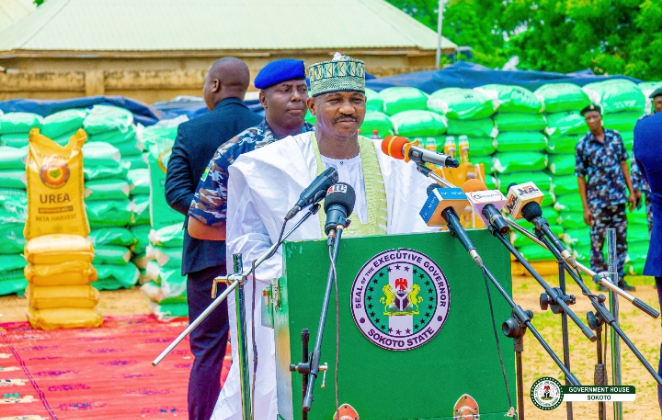
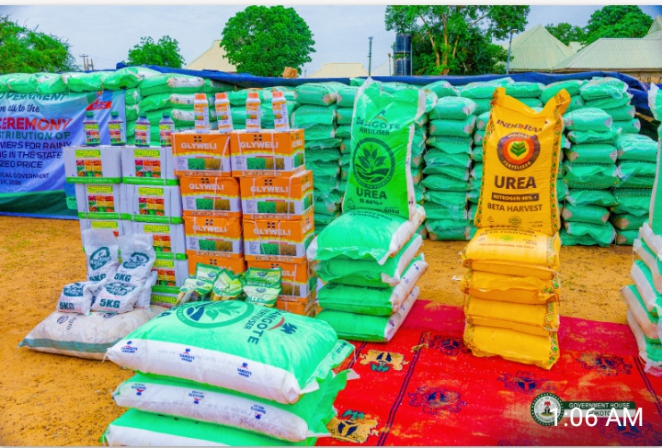
Governor Aliyu’s flag-off of free fertiliser distribution across Sokoto State’s 23 Local Government Areas belongs to consequential leadership class, and it deserves scrutiny precisely because it reveals how a state government is choosing to confront one of Nigeria’s most persistent structural problems: the gap between agricultural input procurement and the farmers who actually need those inputs.
The numbers are not trivial. The procurement of 157,800 bags of assorted fertiliser, worth over N7.7bn, alongside 12,800 bags of improved seed varieties and additional herbicides and insecticides, represents a substantial fiscal commitment to Sokoto’s farming population.
Combined with the earlier acquisition of 250 Massey Ferguson tractors at a cost exceeding N22bn, and the prospect of further 100 Belarus tractors through the Bank of Agriculture, is a mechanisation and input strategy of genuine scale. Few states have matched this level of investment in a single wet season cycle.
What makes this intervention worth examining, however, is not merely its size but its candour about past failure. Governor Aliyu did not present this latest distribution as a triumphant continuation of an unbroken success story. Instead, he openly acknowledged that three previous rounds of free distribution had been undermined by middlemen, who diverted commodities meant for genuine farmers, and that this failure had forced his administration to switch to subsidised sales rather than outright free distribution.
This is a rare moment of institutional self-correction voiced publicly by a sitting governor, and it matters more than the tonnage figures themselves.
Nigerian agricultural policy has long suffered from a credibility problem rooted precisely in this diversion dynamic. Fertiliser subsidy schemes, dating back decades, have repeatedly been captured by politically connected distributors, cooperative society officials, and black-market traders who resell subsidised inputs at commercial rates, leaving the smallholder farmer no better off than before the intervention was announced.
That Governor Aliyu named this problem explicitly, rather than glossing over it with ceremonial rhetoric, suggests an administration that is at least attempting to learn from its own record rather than simply repeating it.
Whether the newly introduced anti-diversion measures will hold is, of course, a separate question, and one that cannot be answered by a flag-off ceremony alone. The Governor’s own framing was conditional: free distribution will continue only if the sharp practices of unpatriotic middlemen are successfully curbed.
This is a reasonable position, but it also places the burden of proof on implementation rather than intention. The involvement of the 23 local government chairmen, who pledged close monitoring of the distribution process, and the establishment of a dedicated supervisory committee under Alhaji Chuso Abdullahi Dattijo, are institutional mechanisms worth watching over the coming months, not simply applauding today.
There is also a broader policy logic at work that deserves recognition. By pairing input distribution with mechanisation, through both state-procured tractors and the Federal Government’s Belarus tractor arrangement via the Bank of Agriculture, Sokoto is attempting to address two bottlenecks simultaneously: access to planting materials and the capacity to work larger areas of land efficiently.
This dual approach, if sustained, has more potential to shift yield outcomes than input distribution alone, since mechanisation extends the area that fertiliser and improved seeds can meaningfully serve.
The endorsement offered by the Sultan of Sokoto, Alh. Sa’ad Hm
v4and the state’s traditional and religious establishment carries weight in a region where agricultural behaviour is often shaped as much by community trust as by government directive.
Farmers who might be sceptical of official pronouncements are more likely to engage seriously with a programme that carries the visible backing of respected traditional authority.
None of this guarantees that Sokoto’s food sufficiency ambitions will be realised in the coming season. Nigeria’s agricultural sector remains vulnerable to insecurity, climatic unpredictability, and logistical friction that no single state government can fully control. But Governor Aliyu’s willingness to name past institutional failure, pair it with a scaled and conditional response, and back it with mechanisation investment offers a more credible template for food sufficiency policy than the ceremonial abundance of previous distribution cycles.
The test, as always in Nigerian agricultural governance, will lie not in the flag-off but in the harvest.
Lawal Jet Kaugama, a commentator on national issues, writes from Kano