
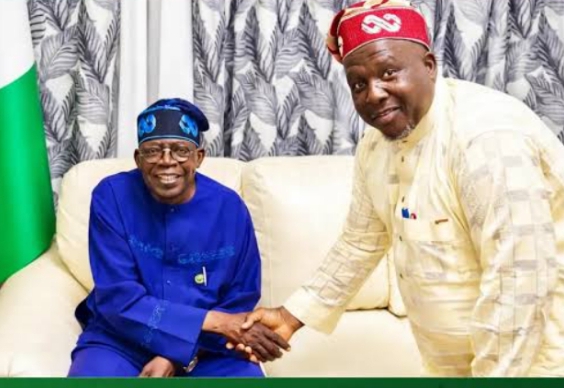
Ibrahim Masari, grassroots connection and quiet political loyalty
By Lawal Jet Kaugama
There is a certain kind of political service that rarely trends on social media, yet holds together the machinery that keeps a government functioning. It is not the service of grand speeches or viral soundbites, but the patient, unglamorous work of consultation, mobilisation and relationship-building.
Few figures in President Bola Ahmed Tinubu’s political apparatus embody this style of service more consistently than Alhaji Ibrahim Kabiru Masari, Special Adviser to the President on Political Affairs.
Masari’s trajectory within the Presidency tells its own story. He joined in 2023 as Senior Special Assistant on Political Affairs, a position from which he quietly built a reputation for reliability and reach across Nigeria’s political terrain. His elevation to Special Adviser in March 2026 was not an accident of patronage; it was, by every visible indication, a recognition of sustained performance. That he now works alongside Alhaji Yau Darazo in coordinating political affairs at the highest level of government speaks to the scale of trust the presidency has placed in his hands.
To understand why this trust is well-placed, one needs to only look at the record.
Masari’s roots in party organisation run deep, his tenure as National Welfare Secretary of the All Progressives Congress under Adams Oshiomhole’s chairmanship gave him a first-hand education in the delicate art of managing competing interests within a broad political coalition. That grounding shows in how he now operates: not as a distant appointee issuing directives from Abuja, but as a political actor embedded in the realities of the communities he serves.
Consider the empowerment initiative he sponsored in Katsina South Senatorial District in March 2024. More than 306 million naira in cash and material support, sewing machines, welding equipment, irrigation tools, fertiliser, motorcycles, buses, reached ordinary citizens in a programme attended by the Vice President himself and a gathering of governors.
Critics may debate the proper boundaries between personal philanthropy and public office, but few can dispute that such gestures, when channelled toward genuine economic empowerment rather than mere spectacle, respond directly to the needs of citizens too often left waiting for government to reach them.
Masari’s value to the Tinubu administration, however, extends well beyond grassroots generosity. His inclusion on the APC Committee on Strategy, Conflict Resolution and Mobilisation, inaugurated by President Tinubu in December 2025 ahead of the 2027 elections, places him at the centre of one of the party’s most consequential internal processes.
Conflict resolution within a governing party is rarely dramatic, but it is essential, and an adviser trusted with that responsibility is one whose judgment carries weight far beyond ceremonial duties.
This same instinct for bridge-building was on display at the April 2026 engagement with Renewed Hope Ambassadors, where Masari stood among senior officials as the President called on the organisation to intensify grassroots sensitisation on economic reforms.
It was equally visible in his recent political consultations in Katsina, where, surrounded by lawmakers and local government leaders, he made a public appeal for continued unity in the state, a reminder that political stability, particularly in Nigeria’s North, is not sustained by decree but by constant, deliberate engagement.
Perhaps most telling is his representation of the President at the Jigawa State Academic Forum, where more than a thousand academics from 48 tertiary institutions gathered to discuss governance, education and human capital development. That Masari was entrusted to carry the President’s message to Governor Umar Namadi, described by the President himself as his “Dan Amanar Gwamna”, and to a forum of the state’s intellectual leadership, underscores how far his portfolio has expanded beyond conventional politicking into substantive engagement with Nigeria’s development agenda.
Beyond politics, Masari’s social contributions add another dimension to his public profile. The disclosure, at the June 2026 prayer session honouring the President’s late mother, Abibatu Mogaji, that over 250 hand-pump boreholes had been constructed across nine northern states in her memory, alongside plans for an Islamic centre in Abuja and a mosque in Rigasa, reflects a form of service that blends faith, memory and community welfare.
If Nigeria’s political class is often criticised for prioritising personal ambition over public duty, Masari’s record offers a counter-example worth studying. His work suggests that political advisers can be more than campaign strategists; they can be genuine conduits between government and citizens, translating policy into presence and presence into trust.
As Nigeria’s political environment intensifies ahead of 2027, officials like Masari, those who combine party loyalty with tangible community engagement, may well determine how effectively the Renewed Hope Agenda reaches the grassroots it claims to serve.
Should more of the President’s aides embrace this model of quiet, consistent engagement across every state, particularly in the North, the burden of direct campaigning may fall less heavily on the President himself.
To Masari, the future holds greater promise.
Lawal Jet Kaugama, a commentator on national issues, writes from Kano. He can be reached on [email protected]