
UBEC begins 10-year basic education roadmap implementation in October
By Uji A Iliyasu, Abuja
The Universal Basic Education Commission (UBEC) will commence the implementation of its 10-year Universal Basic Education (UBE) Roadmap, 2026–2035, in the first week of October.
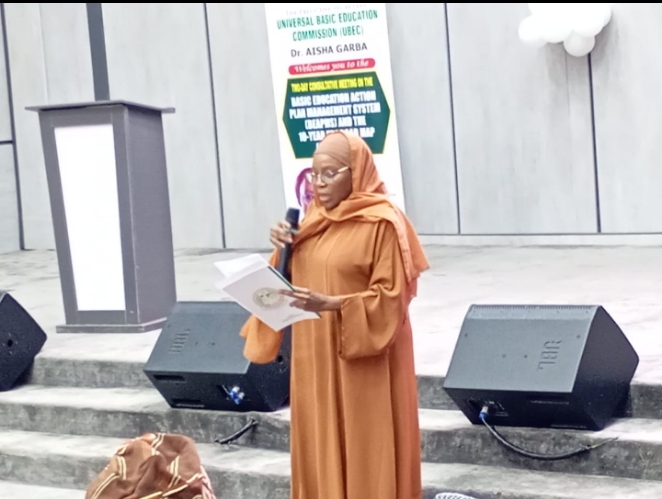
The UBEC Executive Secretary, Dr Aisha Garba, announced this in Abuja on Monday at a two-day consultative workshop with chairmen of the 36 State Universal Basic Education Boards (SUBEBs) and directors of the commission.
Garba said the roadmap would replace the practice of implementing isolated infrastructure projects with a comprehensive approach that addresses the needs of individual schools.
She also unveiled the Basic Education Action Plan Management System (BEAPMS), a digital platform designed to improve planning, transparency and monitoring of basic education interventions nationwide.
Garba said UBEC is adopting a “whole school approach” under the new roadmap, requiring states to identify and address all critical gaps in a school before their action plans can be approved.
“For any state to do renovation, you have to do a whole school approach. A whole school approach means, you take a school and you look at all the gaps,” she said.
Garba said the approach would prevent situations where classrooms or furniture were provided without other essential facilities required for a functional learning environment.
“You don’t just put in a furniture or you drop two blocks of classrooms and you leave because you want to give out awards. No, you have to take in all the comprehensive needs of that particular school,” she said.
She explained that where a school required fencing, toilets, furniture or computers, such needs would be incorporated into its intervention plan. Similarly, additional classrooms would be matched with adequate toilet facilities based on projected enrolment.
The executive secretary also announced a revision of the matching grant formula to allow states to deploy UBEC funds according to their specific education needs.
She said the previous formula focused largely on new infrastructure, leaving some states unable to access funds effectively because their priorities had shifted to the maintenance and improvement of existing schools.
“The new formula allows each state to look at their own needs. If their needs on the ground is furniture, if their needs on the ground is renovating all schools to ensure that our schools now have fencing, have computers, have furniture, then they are allowed to do that,” she said.
She added that the revised framework could also support enrolment materials and additional teachers where states identified increased enrolment as a priority.
On BEAPMS, Garba said the platform would enable parents and communities to monitor projects implemented under the roadmap.
She said information on funds accessed by each state, as well as details of projects being implemented, would be published on the commission’s website.
“This will also allow us to bring in the community to be part of the monitoring of the projects that we do on the ground,” she said.
Garba added that the initiative would enable communities to hold UBEC and implementing authorities accountable for funds accessed, projects executed and the quality of interventions delivered.
The commission said the digital platform had been under development for more than a month, adding that SUBEB chairmen had been onboarded ahead of full implementation in October.
Also speaking, the Dean of SUBEB Chairmen, Prof. Shehu Adaramaja, said the consultation would help stakeholders establish a common direction for basic education delivery over the next decade.
Adaramaja, who is also the SUBEB Chairman of Kwara State, said the meeting was designed as a hands-on exercise, with directors of research and statistics expected to participate actively in developing the framework that would guide states’ basic education action plans.
He noted that UBEC’s intervention mandate had expanded beyond physical infrastructure to include other components aimed at strengthening basic education delivery.
Earlier, UBEC Director of Physical Planning, Nura Ibrahim, said the workshop would enable stakeholders to review and validate the proposed roadmap while drawing on their technical expertise and experience in implementing basic education programmes across the states.