
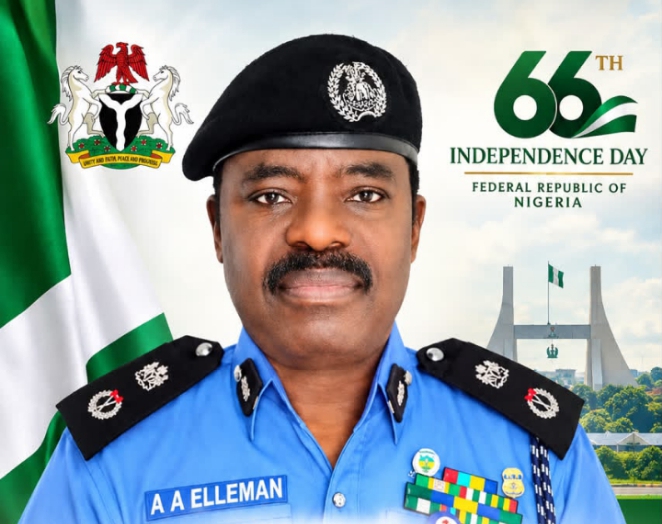
CP Elleman: Duty, professionalism and trust
By Lawal Jet Kaugama
Policing is rarely praised until it fails. In Niger State, a vast territory that has long contended with banditry, insurgent threats and the usual friction of a growing capital, the arrival of a new Commissioner of Police could easily have passed as routine.
In CP Adamu Abdullahi Elleman, however, the state has found an officer whose conduct suggests that experience, legal training and a sense of duty can still define public service.
CP Elleman assumed office as the 38th Commissioner of Police in Niger State, taking over from AIG Shawulu Ebenezer Danmamman, who was promoted and redeployed to a higher office. He is no newcomer to the demands of the job. A son of Kaugama Local Government Area of Jigawa State, he joined the Nigeria Police Force as a Cadet Assistant Superintendent of Police on 25 June 1994 and has now served for over 31 years.
His academic grounding is as notable as his service record. He holds a Diploma, an LL.B (Hons) and an LL.M from Ahmadu Bello University, Zaria, and attended the Nigeria Law School before being called to the Nigerian Bar.
His professional development took him through the Police Staff College, Jos, the National Institute of Police Studies, and specialised courses in the United States, the United Kingdom and South Africa.
His postings reflect that breadth. He served as Director of Intelligence, Investigation and Enforcement at the Federal Inland Revenue Service in 2009, and headed the Inspector-General’s Monitoring Unit in 2019 and 2023.
Most recently, he was Commissioner of Police in charge of the Maritime Command in Lagos. Such a trajectory, spanning intelligence, enforcement, monitoring and the complexity of a maritime command, is exactly the preparation a state like Niger requires.
The first duty of any police commander is to keep people safe, and CP Elleman has approached it with seriousness. Aware that the threats facing Niger State call for more than goodwill, he has made a case to the Inspector-General of Police for reinforcements, armoured personnel carriers and advanced technology.
This is leadership that names the gaps honestly and asks for the tools to close them.
On the ground, he has pursued targeted sweeps and enforced a curfew to flush out hoodlums from Minna, the state capital. He has also adopted a zero-tolerance policy against thuggery, a posture that matters because organised street violence often grows into something worse when it goes unchecked.
Importantly, he pairs firmness with partnership, calling on residents and stakeholders to cooperate with the Command, because no police force, however well equipped, can secure a community that does not trust it.
A police chief’s character shows most clearly when things become politically sensitive or institutionally uncomfortable. When the ban on political campaigns was lifted by INEC, CP Elleman directed Area Commanders and Divisional Police Officers to provide tight security and to remain strictly neutral.
In a democracy, that instruction is no small thing. Public confidence in elections depends heavily on the impartiality of those who guard them.
His commitment to accountability extends even to matters involving other agencies. In September 2026, he ordered an immediate and comprehensive investigation into the deaths of several suspected illegal miners who died in the detention facility of the Nigeria Security and Civil Defence Corps. Whatever the findings, the decision to investigate promptly and openly sends the right message: every life matters, and no custodial death should be allowed to disappear into silence.
He has also warned officers firmly against corruption and unprofessional conduct, insisting on strict adherence to professional ethics. A commander who sets that standard for his own men earns the moral authority to demand it of others.
True leadership looks after those who serve and those who are vulnerable. Under CP Elleman, the Command presented Group Life Assurance cheques totalling N11.4 million to the families of 10 officers who died in the line of duty. For a bereaved family, such support is more than money. It is proof that the institution does not forget those who gave everything for it, and it strengthens the morale of serving officers who know their families will not be abandoned.
His attention to vulnerable citizens is equally commendable. By driving capacity-building for Gender Desk Officers, he has pressed for sexual and gender-based violence cases to be handled with empathy and professionalism. Survivors often fall silent because they fear judgment or indifference at the police counter. Training officers that respond with dignity can change that.
No police commissioner can single-handedly solve Niger State’s security challenges, and CP Elleman himself has been candid about needing public cooperation. But the early signs are encouraging: legal acumen, operational firmness, political neutrality, respect for accountability and genuine care for both officers and citizens.
The people of Niger State, and the media and community leaders who shape public opinion, should give him the support and information that effective policing requires. In return, they have every reason to expect an officer who understands that the law is a shield for the people rather than a weapon against them.
CP Elleman has made a strong start. The task now is to sustain it, which he surely will beyond Nigeria@66.
Lawal Jet Kaugama, a commentator on national issues, writes from Kano. He can be reached on [email protected]