
Notes on Gov Namadi’s sure bet for Jigawa’s industrial development
By Lawal Jet Kaugama
Few leaders understand, as clearly as Governor Umar Namadi of Jigawa State, that education is the surest vehicle of societal transformation, and directing Jigawa on this noble path to greatness.
Nations and states do not rise on physical resources alone in this golden era of knowledge economies across the globe. They rise on the minds trained on science and technology to harness those resources to better use.
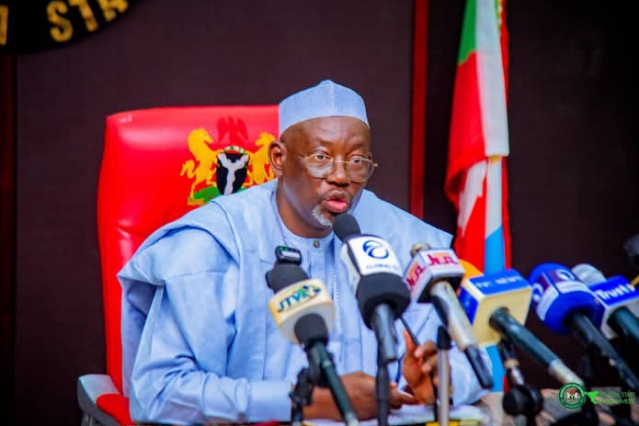
Earlier this week, that conviction found its most compelling expression yet, when the Governor bade farewell to 65 Jigawa scholars departing for the People’s Republic of China to pursue postgraduate studies in agriculture and allied disciplines.
The numbers tell a story of deliberate ambition. Fifty master’s students will spend three years abroad, while fifteen doctoral candidates will spend five.
These are not casual excursions. They are long, demanding commitments of time, talent and public money, made in the firm belief that the future of Jigawa’s agriculture will be decided in laboratories, research stations and lecture halls as much as on the farmlands.

Critics of such investments often ask a lazy question: why spend on scholarships when farmers need fertiliser, seeds and tractors?
The answer is that Governor Namadi has refused to accept a false choice. Inputs and equipment matter, and his administration has not neglected them. But inputs without knowledge produce only temporary relief.
A farmer who receives a bag of seed today still faces tomorrow’s pests, tomorrow’s droughts and tomorrow’s market shocks. Lasting answers come from research, technology and the trained minds who generate them.
That is the logic behind the governor’s twin-track approach. While sending scholars abroad, his administration is strengthening agricultural research institutions at home and backing studies on crops that define Jigawa’s economy: sesame, wheat, rice and hibiscus. These are not arbitrary choices. They are the crops on which thousands of households depend on for food and income, and on which the state’s export potential rests.
Better varieties, improved yields, smarter processing and stronger value chains all begin with serious scientific inquiry and tapping.
China is a deliberate choice of destination. Within a few decades, it has transformed itself from a country that struggled to feed its people into one of the world’s agricultural and technological powers. Its achievements in crop science, mechanisation, irrigation and agribusiness offer lessons that Jigawa, a state with vast arable land and a farming population, can ill afford to ignore. Therefore, sending scholars to learn at the source is both pragmatic and visionary.
It is also a vindication of a principle too often forgotten in public life: that the best investments are those whose returns outlive the political cycle.
A road may be commissioned and admired within a year. A scholar’s PhD takes five years, and its full impact may take a decade more to be felt.
Governor Namadi has chosen to plant trees whose shade and fruits will benefit those who come after him. That is the mark of statesmanship over mere politics.
Yet the governor’s message to the scholars carried an equally important note of accountability, and it deserves emphasis. He urged them to take the opportunity seriously, to remain focused, to respect the laws and culture of their host country, and to make the most of their time abroad.
Above all, he reminded them that their studies are funded with public resources. This is the language of a leader who understands that public money is a sacred trust. Every naira spent on these scholarships belongs to the people of Jigawa, and every scholar carries the responsibility to repay that trust with service.
That expectation is neither harsh nor unreasonable. Scholarship is a privilege, but it is also a contract. The farmer in Birniwa, the trader in Hadejia and the young graduate in Dutse are all stakeholders in this nation building programme. They are entitled to expect that those who go will return, and that what they bring back will improve lives.
The scholars must, therefore, see themselves not merely as beneficiaries, but as ambassadors and as custodians of a shared hope renewed.
For Jigawa, the stakes could hardly be higher. Agriculture remains the backbone of the state’s economy and the livelihood of the majority of its people. A generation of home-grown experts in crop science, agronomy, agricultural engineering and related fields could reshape how the state cultivates crops, processes and sells what it grows.
This could attract investment, create jobs, reduce post-harvest losses and deepen food security. In short, it could turn a promising agricultural base into a genuine agricultural economy.
Governor Namadi deserves commendation for this vision, and the people of Jigawa deserve to understand its significance. Education is not an expense to be endured. It is the foundation on which every other development is built.
In sending 65 of the state’s bright minds to study abroad, he has made a statement about what kind of future he intends to build: one grounded in knowledge, skill and purposeful leadership.
The scholars have been sent off with prayers and high expectations. The task now is to ensure that the investment bears fruit.
When they return, better equipped and eager to serve, Jigawa will begin to harvest what this administration has had the foresight to plant.
Thus the Namadi administration is worth celebrating.
Lawal Jet Kaugama, a commentator on national issues, writes from Kano. He can be reached on [email protected]