
Gov Ahmed Aliyu: Your compassion transcends party, ethnicity and religion
By Lawal Jet Kaugama
At a time when Nigeria continues to grapple with political divisions, ethnic suspicions, and religious sensitivities, Sokoto State stands out for a refreshing reason: leadership defined by humanity.
Gov Aliyu’s actions consistently demonstrate that true governance is not bias to partisan lines or sectional loyalties, but about uplifting the people regardless of where they come or what they believe.
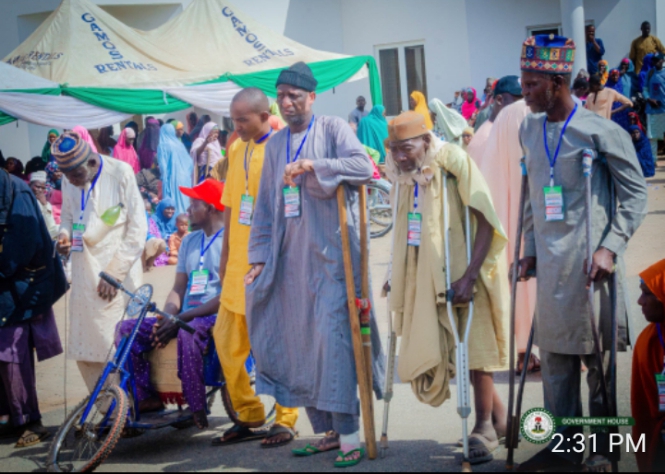
Gov Aliyu’s recent collaboration with the Federal Government and the Renewed Hope Initiative (RHI) during this year’s World Disability Day is yet another powerful testament to his inclusive leadership style.
The Director General, Media and Publicity to Sokoto State Government , Abubakar Bawa, on Thursday said the disbursement of N64 million in grants to persons living with disabilities in Sokoto State, N50 million from the First Lady, Senator Oluremi Tinubu, and N14 million through the state government , was more than a ceremonial gesture. It reflected a philosophy of governance anchored in compassion, equity, and justice. For Governor Aliyu, the well-being of the most vulnerable segments of society is not a political strategy; it is a moral obligation. His administration’s policies continue to emphasize social welfare, empowerment and dignity for those most often ignored.
One of the clearest examples of this commitment is the upward review of monthly stipends for persons living with disabilities from N6,500 to N10,000. At a time when economic hardship weighs heavily on many families, the governor ensured that those on the margins are not abandoned. With 6,679 registered beneficiaries and plans to capture even more, this intervention shows a depth of empathy that cuts across demographics. Whether a beneficiary voted for him, belongs to his political party, or even shares his ethnic or religious background is immaterial. What matters is their humanity.
The provision of 1,000 hand-cycles to persons living with physical disabilities further reinforces this point. Mobility is not merely a matter of convenience; it is central to dignity, independence and participation in society. By fulfilling this promise promptly, Governor Aliyu validated the lived experiences of people often relegated to invisibility. This is leadership rooted in listening, understanding and acting.
Similarly, creating Ramadan feeding centres for persons with disabilities underscores his awareness of the social and spiritual dimensions of people’s lives. Ramadan, for Muslims, is a month of compassion, charity and togetherness. By establishing dedicated centres where people with disabilities can break their fast in comfort, the governor has shown that inclusive governance also involves respecting cultural and religious practices in a way that honours human dignity.
Even beyond his own initiatives, Governor Aliyu’s partnership with the Federal Government and the First Lady demonstrates statesmanship. By aligning with the Renewed Hope Initiative — which is empowering 250 persons with disabilities in each state with N200,000 grants — he ensured that Sokoto residents fully benefit from national programmes. The First Lady’s acknowledgment of the governor’s support is a recognition that genuine development requires collaboration, not competition. It also affirms that the governor’s concern is not political leverage; it is the welfare of the people.
What makes this even more significant is the diversity within Sokoto. The state is home not only to different ethnic groups but also to various faith communities and political interests. Yet, in all his interventions, Governor Aliyu has never prioritized one group over another. Instead, he has consistently demonstrated that leadership is stronger when it rises above divisions. His openness to all — widows, orphans, victims of communal clashes, internally displaced persons, market women, youth and persons with disabilities — builds trust across communities.
The goodwill message of Sultan Muhammad Sa’ad Abubakar, delivered by Ubandoman Arkilla, further illustrates that the governor’s approach resonates widely. When traditional institutions, religious leaders and civil society acknowledge the sincerity of a government’s efforts, it speaks to credibility earned, not manufactured. The Sultanate Council’s continued support is a reflection of leadership that respects cultural institutions and serves the people with humility.
The atmosphere at the World Disability Day celebration — culminating in a lively para-soccer match between the Governor’s team and his wife’s team — reinforced the spirit of inclusion. Sports have a way of dissolving barriers, reminding society that ability matters more than disability, and unity matters more than difference. The presentation of a trophy by the Sokoto Para-Soccer Team symbolized their pride in an administration that recognizes their worth.
In a country where political leaders are often judged by how well they cater to their own constituencies, Governor Ahmed Aliyu offers a different blueprint. He leads with empathy, acts with fairness, and governs with a sensitivity that treats every citizen first as a human being. His administration’s focus on people-oriented projects — regardless of party affiliation, ethnicity or religion — is redefining governance in Sokoto State.
If Nigeria is to move forward, it needs more leaders who, like Governor Aliyu, see humanity before politics, and service before personal gain. His example is a reminder that inclusive leadership is not only possible; it is transformative.
Lawal Jet Kaugama, a commentator on national issues, writes from Kano