
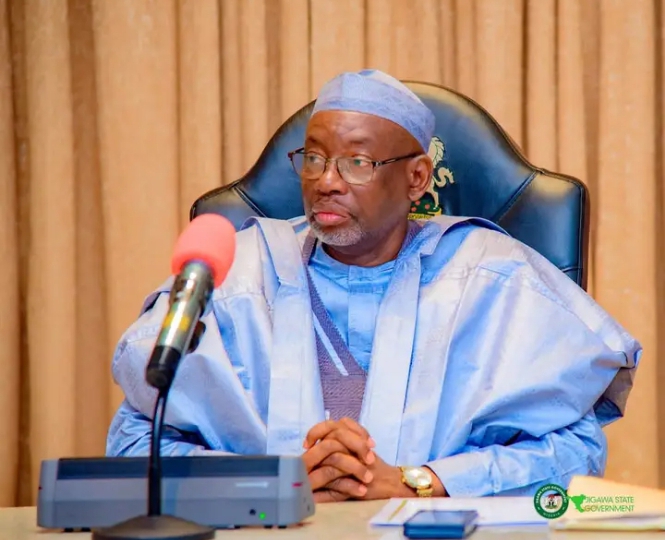
Namadi’s renewed vision for rural progress and sustainable development in Jigawa
By Lawal Jet Kaugama
In an era when governance in many states is often bogged down by rhetoric without results, Jigawa State under the stewardship of His Excellency, Malam Umar A. Namadi, FCA, stands out as a shining example of purposeful leadership. The resolutions reached at the recent State Executive Council meeting held on Monday, 10 November 2025, have once again reinforced the Governor’s commitment to tangible development, prudent management of resources, and equitable service delivery.
Gov Namadi’s administration has consistently demonstrated that governance is not about grandstanding or empty promises, but about impactful decisions that touch lives. The two major resolutions, rural electrification enhancement and the construction of solar-powered water supply schemes for new housing estates, underscore the administration’s vision of a Greater Jigawa, where development is inclusive, sustainable, and forward-looking.
The approval of ₦1.35 billion for the maintenance and upgrade of existing electrification projects across the state is not merely an infrastructural investment; it is a statement of intent—a bold declaration that no community in Jigawa should remain in darkness. The scope of this project, which includes the installation of transformers, inter-town connection of 33KV lines, and replacement of damaged electricity poles, cuts across strategic localities such as Madaka, Bosuwa, Mai Tsamiya, Unguwar Gawo, Yandamo, Farin Dutse, Giginya, Kwanar Dindu to Bulangu, Kanya Babba, and Garki.
Each of these communities represents a vital node in Jigawa’s rural economy—where agriculture, small-scale trade, and local enterprise thrive. By investing heavily in electrification, Governor Namadi is empowering these communities to expand their productive capacity. Reliable power supply is the lifeblood of modern development; it energises small businesses, supports education, facilitates healthcare delivery, and reduces rural-urban migration. With this initiative, the administration has reaffirmed its understanding that electricity is not a luxury but a necessity for growth.
Equally commendable is the approval of ₦378.7 million for the construction of solar-powered water supply schemes in the new Danmodi Housing Estates located in Birnin Kudu, Kafin Hausa, Kazaure, Ringim, and Nguru Road–Hadejia. This project, though modest in cost compared to larger capital works, represents a profound leap in sustainable development. It aligns perfectly with the Governor’s 12-Point Agenda, particularly the emphasis on affordable housing, environmental sustainability, and renewable energy.
Water, like power, is a fundamental necessity. The decision to integrate solar technology into the provision of water supply shows a remarkable understanding of the future of infrastructure. Jigawa, with its largely rural population and vast sunny climate, is ideally positioned to harness renewable energy. By adopting solar power for public utilities, the Namadi administration is reducing dependency on the national grid, cutting operational costs, and demonstrating environmental responsibility.
The Danmodi Housing Estates project is a microcosm of a broader vision—a blueprint for modern, self-sustaining communities where housing, water, and energy are interlinked to support dignified living. It reflects a government that is not just building structures, but building lives. The emphasis on renewable energy solutions also complements the global call for climate action and positions Jigawa as a state that is thinking beyond the present.
What is particularly striking about these initiatives is the careful balance between urban and rural priorities. Governor Namadi’s policies do not favour one over the other; rather, they create a developmental bridge that ensures equitable distribution of resources. While the rural electrification projects will revitalise the state’s agrarian backbone, the housing and water projects will strengthen urban resilience. Together, they form the pillars of a balanced development agenda.
Critics often claim that state governments in Nigeria spend too much on paper plans and not enough on execution. But Jigawa under Namadi has proven otherwise. Each policy announcement is backed by a clear cost outline, defined scope of work, and transparent accountability. The administration’s communication, as exemplified by the detailed press release from the Honourable Commissioner for Information, Youth, Sport and Culture, Sagir Musa Ahmed, is open and factual—a refreshing hallmark of good governance.
Governor Namadi’s background as a Chartered Accountant (FCA) is clearly reflected in his leadership style—measured, meticulous, and financially disciplined. His approach to development combines fiscal prudence with social responsibility. By prioritising projects that directly impact people’s lives, he has shown that governance can be both strategic and compassionate.
As the state continues to execute its ambitious projects under the Greater Jigawa vision, it is evident that the Namadi administration is building not only infrastructure but also trust, confidence, and hope. The recent council resolutions are not isolated actions; they are part of a consistent pattern of purposeful governance that aims to make Jigawa a model for others to emulate.
In conclusion, Malam Umar A. Namadi has proven once again that leadership is about vision translated into measurable action. His administration’s investment in power and water infrastructure is an investment in the people—an investment that will yield dividends in economic growth, social stability, and human dignity. If other states adopt such a focused and sustainable approach, Nigeria’s collective path to development would become far clearer.
Indeed, in the light of these bold and thoughtful initiatives, it is fair to say that Jigawa State is in capable hands, and its future, under Gov Namadi, looks brighter than ever.
Lawal Jet Kaugama, a commentator on national issues, writes from Kano