
Notes on Nigeria’s romance with France
By Uji A Iliyasu
If you must dine with the devil, you must use a long spoon; when he grabs the other end of the spoon, you leave your end and run away.
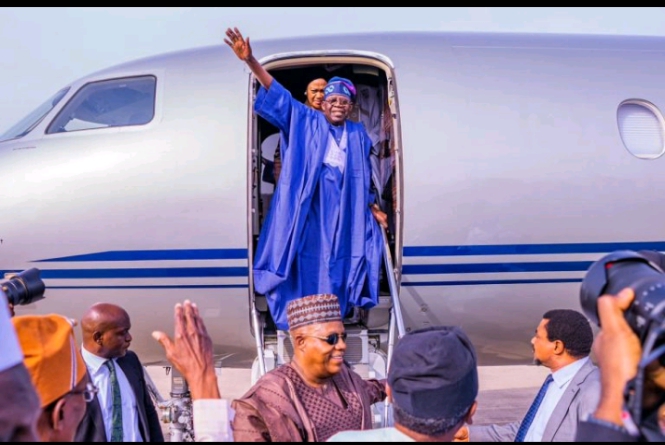
As the world watches a dramatic shift in Africa’s geopolitical consciousness, Nigeria finds itself on the wrong side of history. While the winds of liberation blow strong across the Economic Community of West African States (ECOWAS), with Burkina Faso, Mali, and Niger rejecting the neocolonial grip of France, President Bola Ahmed Tinubu, inexplicably, is romancing the very empire that Ibrahim Traore of Burkina Faso, and other France’s babies are fleeing from like a plague.
At a time when the continent is waking up to the exploitative realities of colonial hangovers, Nigeria, Africa’s largest nation, should be leading a new vision of independence and unity. Instead, Tinubu is busy seeking the favour of France’s President Emmanuel Macron, a man younger than his first son.
This absurd relationship of an aging African president with a Western leader whose predecessors plundered and brutalised our continent, raises disturbing questions. While Burkina Faso’s Ibrahim Traoré speaks of sovereignty and dignity for Africans, Tinubu seems to be pushing Nigeria into the arms of a former colonial master.
Let it be clear to compatriots that France, like USA or UK, is not interested in the development of any country in Africa; France’s nterest is in Africa’s resources, using partnership, either in trade, science or art as a cover.
For decades, France has maintained parasitic control over its former colonies, controlling currencies, influencing elections, and propping up corrupt leaders who serve its interests. The recent expulsion of French troops from Mali and Niger is not a coincidence, it is the result of growing awareness among Africans that France’s presence is synonymous with exploitation, not partnership. This exploitation was entrenched during their colonial ideal in it’s policy of assimilation, where blacks in their colonies, were brainwashed, to see themselves as white frenchmen and women.
Tinubu, as chairman of ECOWAS, has failed to read the handwriting on the wall; the regional bloc is already under pressure as Mali, Burkina Faso, and Niger have pulled out, rejecting both French control and the toothless bureaucracy of ECOWAS.
These are not rogue states; these are awakening voices. Instead of listening, Tinubu has chosen to alienate them further by aligning with the very power they oppose. This is not leadership, it is a betrayal.
Africa’s history is filled with leaders who dared to dream of a united, sovereign continent, many of whom were silenced by the very imperialist forces Tinubu now seeks to appease. Patrice Lumumba in Congo, Thomas Sankara in Burkina Faso, Muammar Gaddafi in Libya, Murtala Mohammed in Nigeria, and even Ibrahim Traoré today, all faced, or are facing, the wrath of global powers threatened by African autonomy.
These leaders shared a vision of Africa for Africans, and most of them paid for it with their lives.
Take Muaman Gaddafi, for example. At the height of his leadership, Libya’s life expectancy was higher than that of the United States. He provided free healthcare, free education, and housing to his people. But for daring to talk about an African currency, a united African army, and a sovereign continent, he was branded a dictator and eliminated by NATO’s bombs, painfully with the tacit support of African collaborators. Africans were not meant to enjoy such luxury, so it seems to white supremacists.
The pattern is clear: whenever an African leader attempts to take genuine steps towards economic and political independence, Western forces, often in collaboration with traitors at home, in form of pro-democracy rights activists, strike them down. Nigeria too, is no stranger to this.
General Murtala Mohammed was assassinated after he began a bold reform of Nigeria’s civil service and foreign policy. General Sani Abacha, for all his flaws, presided over a period of price stability and attempted to steer Nigeria away from IMF and World Bank dependency. He did not travel to USA, UK or France. His sudden death, blamed on apples and “Indian beauties” is a laughable fairytale masking a likely political assassination.
Under late General Sani Abacha, a tin of milk cost N35 naira, pump price of PMS was N11.00 and raised to N22.00 reluctantly.
Under President Tinubu, the same tin jumped to over N1,000.00. from N200.00 under Buhari in May 2023. Yet we are told to believe he is a democrat and reformer because he opposed Abacha as NADECO activist. What kind of reformer plunges his people into hunger and inflation, while jetting off to beg foreign powers for crumbs?
Every day, Nigerians are dying in hundreds, slumpng to their graves for lack of nutrition, women and girls have turned to prostitutes in order to survive the the harsh economic condition due to the removal of subsidy and devalution of national currency. Because of corruption in public places and overestimation of public work contracts.
Today, Nigeria is bleeding, economically, politically, and spiritually. And President Tinubu, who should be shielding the nation from global scavengers (yanbola in Hausa), is opening the gates. If he must befriend that boy called Macron, let him wait until he leaves office. Then he can dance with France, if he wants, as a private citizen. But while he wears the mantle of Nigeria’s president, he must serve Nigeria’s interests, not our oppressors.
Our nation deserves better. We must not let Tinubu sell Nigeria to Macron. Nigerians must rise and speak against this misplaced loyalty to imperial forces. Macron does not represent a new France; he represents the same old playbook: control, extract, dominate, or assassinate.
Gaddafi spoke of a United States of Africa. Sankara spoke of dignity and self-reliance. Today, young leaders like Traoré echo those dreams. But here we are, still trapped in the delusion that partnership with former colonisers will bring prosperity. Only unity, self-reliance, and a decisive break from exploitative alliances will.
For those who are eating the crumbs from Tinubu’s table: ministers, special aides, directors of agencies and bureaucrats, Tinubu is the best thing that ever happened to Nigeria. Why not? In Africa, we must not talk when we are eating.
Tinubu has a choice: to be remembered as a leader who stood for Africa or one who danced for Europe. Right now, he’s choosing the latter, and it’s a tragic mistake.