
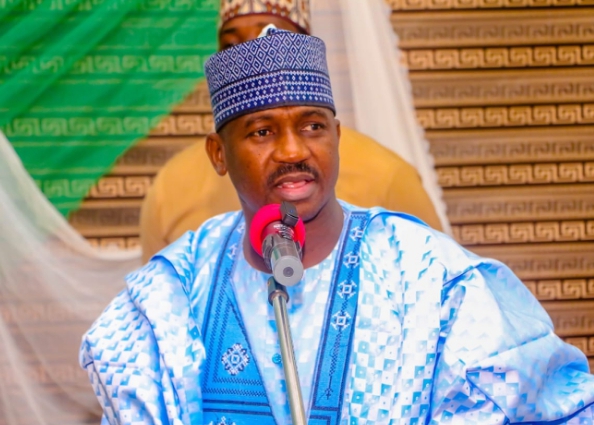
Gov. Ahmed Aliyu: Where Compassion defines leadership
By Lawal Jet Kaugama
In the wake of the devastating flood in Mokwa, Niger State, Governor Ahmed Aliyu of Sokoto State extended heartfelt condolences to his Niger state counterpart, Governor Umar Bago and the affected communities. This gesture, conveyed through a press release by the Secretary to the Sokoto State Government, Abubakar Bawa, on Wednesday, underscores Governor Aliyu’s deep empathy and solidarity with fellow Nigerians during times of crisis. His words, spoken from the holy land of Mecca where he is performing the 2025 pilgrimage, reflect a leader whose compassion transcends borders and whose commitment to humanity is unwavering.
Governor Aliyu’s response to the Mokwa tragedy is more than just a ceremonial condolence; it exemplifies his leadership philosophy anchored in empathy, responsibility, and a genuine concern for the plight of ordinary citizens. He not only expressed his sorrow but also emphasized the deep historical and cultural ties between Sokoto and Niger states—highlighting the disaster as a collective loss felt across regional and state lines. This ability to connect emotionally and spiritually with the people, even during personal commitments such as religious pilgrimages, speaks volumes about the governor’s sincerity and humility.
More importantly, Governor Aliyu’s reaction to the Mokwa disaster is not an isolated act but part of a consistent pattern of people-centred leadership that has defined his administration since assuming office in May 2023.
In just two years, he has demonstrated that governance can and should be a tool for compassion, growth, and transformation. His tenure has been marked by groundbreaking initiatives aimed at improving the lives of Sokoto State residents through massive infrastructure development, economic empowerment, enhanced security measures, and comprehensive social welfare programmes.
His compassion for the people leads him to the development of infrastructures in the state. One of the most visible hallmarks of Governor Aliyu’s administration is the ambitious and far-reaching development of critical infrastructure across Sokoto State. Within just two years, his government has executed over 250 meaningful and impactful projects—an achievement that surpasses those of many past administrations. These projects, equitably spread across all 23 local government areas of the state, include the construction and rehabilitation of roads, bridges, public schools, healthcare centres, and water facilities.
For residents who have long endured the challenges of bad roads, poor access to healthcare, and deteriorating educational structures, these projects are nothing short of transformative. They are not merely infrastructural upgrades; they are lifelines—offering better mobility, improved public health, and enhanced learning environments for thousands.
Recognizing that infrastructure alone cannot lift citizens out of poverty, Governor Aliyu has strategically paired physical development with economic empowerment. He established the Ministry of Skills and Entrepreneur Development and the Ministry of Transportation—both aimed at expanding opportunities for job creation, vocational training, and entrepreneurship.
Through these ministries, the government has initiated soft grants for small and medium-sized enterprises (SMEs), facilitated workshops on skill acquisition, and launched training centres focused on equipping the youth with relevant competencies for today’s labour market. These programmes are specifically targeted at addressing the alarming youth unemployment rate while cultivating a new generation of self-reliant entrepreneurs
Sokoto State, like many parts of northern Nigeria, has experienced its share of security challenges. Rather than offer empty reassurances, Governor Aliyu has taken bold and innovative steps to restore public confidence in security systems.
One of the most commendable initiatives under his leadership is the creation of the Sokoto State Community Guards Corps—a local security outfit designed to support federal security agencies in patrolling communities, gathering intelligence, and responding to threats quickly. This initiative not only improves grassroots surveillance but also empowers local communities to take active roles in their own safety.
To ensure that the community guards are effective, the governor equipped them with 40 Hilux patrol vehicles and 700 motorcycles, enabling better mobility across challenging terrains. Additionally, the Department of State Services (DSS) in the state received a significant upgrade with modern tracking and intelligence systems, further strengthening the state’s capacity for early detection and prevention of security threats.
This proactive approach to safety reveals a leader who understands that peace and stability are prerequisites for sustainable development and economic progress.
Governor Aliyu’s commitment to social welfare is further reflected in his policies aimed at supporting the vulnerable and preserving societal values. From expanding access to healthcare services to enhancing educational facilities, his administration has prioritized human development as the cornerstone of state progress.
Among the key welfare projects is the provision of logistical and operational support for security formations such as the Nigerian Air Force. By aiding in the operationalization of the Air Force unit in Sokoto, his administration not only strengthens defense capabilities but also provides job opportunities and boosts local economies.
Equally significant is his focus on moral and religious reforms. Sokoto, a predominantly Muslim state with deep cultural and spiritual heritage, has under Governor Aliyu’s watch seen renewed efforts to promote ethical conduct and discipline in society. His firm stance on eliminating the sale and consumption of liquour and other intoxicants across the state is a bold but widely supported measure aimed at curbing substance abuse and preserving public morality.
This policy, though tough, reflects a governance style that is both principled and sensitive to the values of the people.
It is no surprise that Governor Aliyu’s leadership style has earned him accolades and national recognition. He has been conferred the prestigious Nigeria Computer Society (NCS) Fellowship for his commitment to leveraging technology in governance and promoting digital inclusion. Furthermore, he was recently honoured as the “Most Media-Friendly Governor” by the Nigerian Television Authority (NTA), a testament to his openness, accessibility, and transparency in public communications.
These honors validate what many in Sokoto already know: that they are being led by a man of vision, discipline, and undeniable passion for humanity.
Governor Aliyu’s heartfelt response to the flood disaster in Mokwa, Niger State, therefore. illustrates a leader who is deeply attuned to the emotional and material needs of Nigerians, regardless of geography. His expression of solidarity, offered while on pilgrimage, was not just symbolic but reflective of a broader philosophy of compassionate governance.
From groundbreaking infrastructure and economic initiatives to comprehensive security reforms and welfare policies, Governor Aliyu has positioned Sokoto State as a beacon of progress and moral integrity in Nigeria. His leadership is a blueprint for what can be achieved when public office is used as a platform to serve with empathy, foresight, and humility.
In a nation yearning for responsive and responsible governance, Governor Aliyu stands out as a shining example of what it means to lead with a heart filled with love for the downtrodden.
Lawal Jet Kaugama, a commentator on national issues, writes from Kano