

Singer Market inferno and Gov Umar Namadi’s solidarity with Kano traders
By Lawal Jet Kaugama
In moments of tragedy, leadership is tested not by speeches made afar but by presence, empathy and decisive actions. Governor Umar Namadi of Jigawa State’s solidarity visit to Kano following the devastating fire outbreak at Singer Market stands as a powerful testament to a humanitarian posture that transcends politics and speaks directly to the heart of public service.
The inferno at Singer Market was not merely an economic setback; it was a human tragedy. Countless traders lost goods painstakingly acquired through years of toil. Families who depend entirely on daily market earnings were suddenly thrust into uncertainty. In such times, communities look instinctively to leaders, not only for policy responses, but for reassurance, comfort and a sense that they are not alone.
Governor Namadi’s decision to join the Vice President Kashim Shettima, and other dignitaries in Kano was therefore, far more than a ceremonial appearance. It was a deliberate act of solidarity. By standing shoulder to shoulder with the government and people of the affected state, he communicated a simple but profound message: hardship in one part of the North is hardship shared by all.
This is the essence of humanitarian leadership, the understanding that governance is not confined by administrative boundaries. Though he serves the people of Jigawa State, Governor Namadi recognises that social and economic ecosystems are interlinked across the region. Markets in Kano supply traders in Jigawa; families are bound by commerce, kinship and culture. A disaster in one state inevitably reverberates in another. His presence acknowledged that shared reality.
What distinguishes this gesture is not merely attendance but tone. Reports from the visit emphasised prayer, empathy and reassurance. In a society where faith and community remain foundational, offering prayers for strength and recovery is not symbolic rhetoric; it is an affirmation of shared values. It signals humility, a recognition that leadership involves moral support as much as material assistance.
Moreover, Governor Namadi’s remarks that “beyond politics and boundaries, we must stand together in times of difficulty” deserve careful reflection. In an era when partisan divisions often dominate headlines, such language re-centres governance on humanity. It reminds citizens that public office is not a battleground for perpetual rivalry but a platform for collective responsibility.
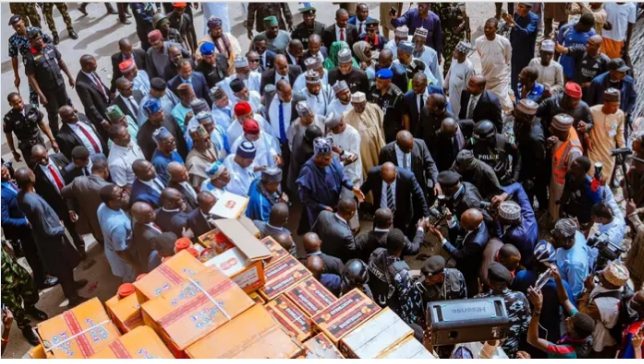
His humanitarian posture was further underscored by his participation in the ceremony marking the defection of Governor Abba Kabir Yusuf to the All Progressives Congress. While political realignments inevitably attract commentary, what stands out is Governor Namadi’s emphasis on cooperation, stability and development rather than triumphalism. In welcoming a counterpart into a new political fold, he framed the moment not as conquest but as an opportunity for strengthened regional partnership.
That approach aligns with the broader assurances of unity and national development repeatedly articulated by President Bola Ahmed Tinubu. Yet Governor Namadi’s strength lies in translating such national themes into practical regional conduct. By demonstrating openness and fraternity, he reinforces the idea that political consolidation should ultimately serve citizens’ welfare.
Critically, humanitarian leadership is not episodic. It must be consistent. Observers of developments in Jigawa note steady efforts towards infrastructural improvement, agricultural support and social stability. The credibility of Governor Namadi’s compassion in Kano is enhanced by his governance record at home. Empathy resonates most when it is supported by evidence of responsible stewardship.
The fire at Singer Market will require more than sympathetic visits. Traders will need financial relief, structural rebuilding and policy safeguards to prevent future disasters. Yet emotional reassurance is a vital first step in recovery. When leaders visibly share in citizens’ grief, they help restore confidence, a currency as essential to commerce as capital itself.
Furthermore, his conduct reinforces an important cultural principle within Northern Nigeria: communal resilience. Historically, communities across the region have weathered adversity through mutual support networks. By physically joining the people of Kano State in their hour of need, Governor Namadi strengthened that tradition at an institutional level. He signalled that inter-state cooperation is not abstract diplomacy but lived solidarity.
In evaluating public figures, it is easy to focus solely on legislative achievements or electoral calculations. However, history often remembers leaders for how they responded in moments of crisis. The image of a governor crossing state lines to console traders whose livelihoods have been reduced to ashes carries moral weight. It conveys accessibility and sincerity, qualities that citizens instinctively respect.
There is also strategic wisdom in compassion. Regions prosper when trust exists between governments. By fostering goodwill in Kano, Governor Namadi strengthens the fabric of collaboration necessary for security coordination, economic integration and infrastructural planning across the North West. Humanitarian gestures, therefore, are not detached from development; they are foundational to it.
In the final analysis, Governor Umar Namadi’s visit to Kano after the Singer Market fire exemplifies a leadership style rooted in empathy, unity and shared destiny. It demonstrates that effective governance balances administrative competence with humane responsiveness. As communities rebuild from the ashes, they will remember not only the flames that threatened their livelihoods, but also the leaders who stood beside them.
Lawal Jet Kaugama, a commentator on national issues, writes from Kano