
How Gov Ahmed Aliyu’s transformation agenda is pulling political bigwigs to APC
By Lawal Jet Kaugama
There is a particular kind of political capital that cannot be manufactured through rhetoric, patronage, or coercion. It is earned, slowly and deliberately, through governance that touches lives.
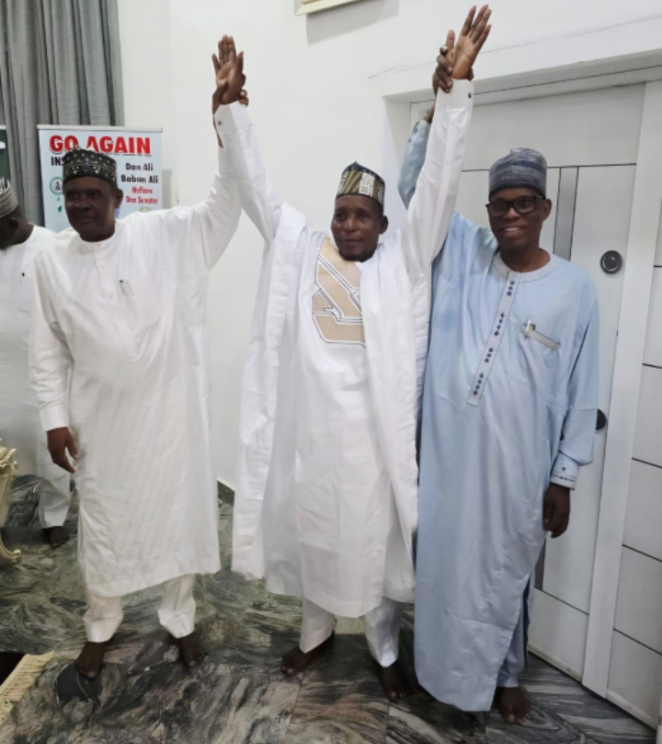
In Sokoto State today, that capital is on full display, and its most recent dividend is the defection of Alhaji Umar Salah, former Director General in the African Democratic Congress (ADC) structure in Tambuwal Local Government Area, to the All Progressives Congress (APC).
This is no ordinary political event. Defections happen across Nigeria’s political landscape with predictable regularity, often driven by personal grievance, the pursuit of office, or the simple arithmetic of self-preservation. But what is unfolding in Sokoto State under Governor Aliyu is something more structural, more telling: a steady, methodical erosion of opposition strength driven not by inducement but by demonstrable performance .
According to a statement .by Abubakar Bawa, Director General, Media and Publicity, Sokoto State Government House, Alhaji Salah’s own words at his reception into the APC are instructive. He did not speak of personal ambition or promises of office. He spoke of the “transformative agenda” of Governor Aliyu, and of developmental projects executed across the state aimed squarely at improving the quality of life of ordinary citizens.
When a seasoned political figure, someone who has held office and understands the machinery of governance from the inside, publicly credits a sitting governor’s record as the reason for abandoning his party, that is not flattery. That is testimony.
And it is a testimony that has been repeating itself across Sokoto State’s 23 local government areas in recent months.
The ADC, once a vehicle carrying real political weight in pockets of the state, has watched a procession of its prominent members walk away, not in ones driven by isolated disputes, but in a pattern that suggests something deeper: a collective recalibration by political actors who read the handwriting correctly and understand where the people’s confidence now resides.
This is the essence of leadership sagacity. It is not loud. It does not depend on the theatre of politics. It is the quiet accumulation of trust that comes from a governor who is seen to deliver rather than merely promise.
Alhaji Umaru Nagwari Tambuwal, who received Salah into the APC on behalf of the party, captured this when he commended Governor Aliyu for “exceeding expectations” in the execution of laudable projects across the state. That phrase, exceeding expectations, is significant. It suggests a governor who has not simply met the baseline demands of office but has gone further than even his supporters anticipated, thereby converting sceptics and opposition figures alike into supporters and advocates.
There is also a broader lesson here about the nature of political coalitions in a functioning democracy. Governor Aliyu’s assurance, echoed by Tambuwal, that there is no discrimination within the APC and that new entrants will be treated equally, speaks to an inclusive political culture, one where merit and commitment, rather than length of membership, determine standing.
This matters enormously in Nigeria’s often fractious political environment, where new entrants to a party can be viewed with suspicion or sidelined.
A governor whose lieutenants can credibly promise equal treatment is a governor who has built an internal culture of fairness, and that culture becomes, in itself, a recruitment tool.
Ahead of the 2027 general elections, the implications of this trend should not be understated. Political observers often measure a governor’s strength through opinion polls, media coverage, or the size of campaign rallies. But the truer barometer, arguably, is this: are political figures with grassroots followings choosing to align themselves with your administration, unprompted, of their own conviction?
Alhaji Salah’s defection, with the promise of his followers’ support as well, is precisely this kind of organic validation. It cannot be bought at scale. It must be earned, project by project, community by community.
Governor Aliyu’s tenure has, by the account of those now joining his political fold, been defined by projects that speak directly to the welfare of the citizenry, projects whose impact is felt in communities rather than merely announced in press briefings.
It is this tangible governance, more than any political strategy, that is drawing figures like Alhaji Salah away from the opposition and into the APC’s expanding tent.
As Alhaji Nagwari Tambuwal rightly prayed, may the Almighty continue to guide and strengthen Governor Aliyu’s efforts to deliver the dividends of democracy to the people of Sokoto State. If the current trajectory holds, the defections witnessed so far may prove to be only the opening chapters of a much larger political realignment, one built not on coercion, but on the simple, powerful currency of results.
Lawal Jet Kaugama, a commentator on national issues, writes from Kano. He can be reached on [email protected]