
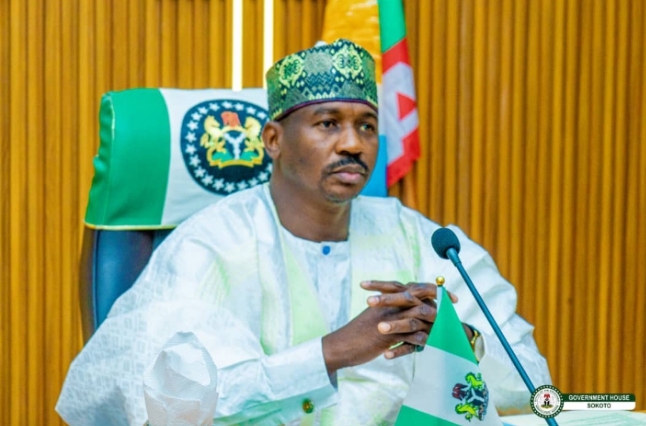
Security First: Gov Ahmed Aliyu’s unrelenting war on banditry in Sokoto
By Lawal Jet Kaugama
When historians come to chronicle the turnaround of security architecture in Sokoto State, the tenure of Governor Ahmed Aliyu will occupy a defining chapter. In a time when banditry has ravaged communities across the North-West, displacing families, disrupting farming seasons, and eroding the very fabric of rural life, Governor Aliyu has chosen a path that few of his predecessors dared to walk with such consistency: sustained, well-funded, and strategically layered investment in the tools of security.
The recent approval by the Sokoto State Executive Council of N1.59 billion for the procurement of 30 additional Toyota Hilux vans, in a statement by the Director General to Sokoto State Government on Media and publicity, Abubakar Bawa, was not merely a budgetary line item , but a statement of intent. It tells bandits terrorising farming communities in Isa, Sabon Birni, Rabah, and beyond that the state is not retreating.
It tells security operatives that their commander-in-chief is not content with promises but is backing them with the operational capacity to chase, corner, and neutralise criminal elements wherever they hide, in forests or on the hills.
What makes this latest procurement significant is not that it stands alone, but that it builds on an already impressive foundation. This is a government that has, prior to this approval, distributed over 200 Hilux vans and 62 armoured vehicles to security agencies across the state.
Few state governments can point to such a scale of sustained logistical support to their security forces.
Security operations are not won by good intentions alone; they are won by mobility, firepower, and the capacity to respond swiftly to distress calls from vulnerable communities. Governor Aliyu appears to understand this truth better than most, and he has matched his understanding with action.
Beyond vehicles, the Council’s approval of an additional 10 Mitsubishi Canter vans and two more Hilux vans for logistics reinforces a holistic approach, which recognises that a security operation is not just about combat vehicles but about the full chain of logistics that keeps personnel supplied, mobile, and ready.
Perhaps even more consequential in the long run is the approval of the Sokoto State Banditry Special Prohibition Law, 2026. Hardware alone does not defeat insurgency; it must be matched with a legal framework robust enough to prosecute, deter, and dismantle the networks that sustain banditry, which include the informers, financiers, and enablers who often operate in the shadows of impunity.
By pursuing this legislation, Governor Aliyu is signalling that his administration intends to fight banditry not just on the battlefield but in the courtroom, closing the loopholes that have historically allowed criminal elements to regroup and strike again.
Critics of government spending often ask whether such huge sums could be better spent elsewhere. But this question misunderstands the nature of security as a foundation for everything else. No meaningful economic development, no functional education system, no thriving agricultural sector can exist where citizens live in fear of abduction, where farmers cannot access their fields, and where entire communities are held hostage by armed criminals.
Security is not competing with development, but a precondition for it. A government that fails to secure its people first has failed at the most basic obligation of governance. Here Governor Aliyu passed with high marks.
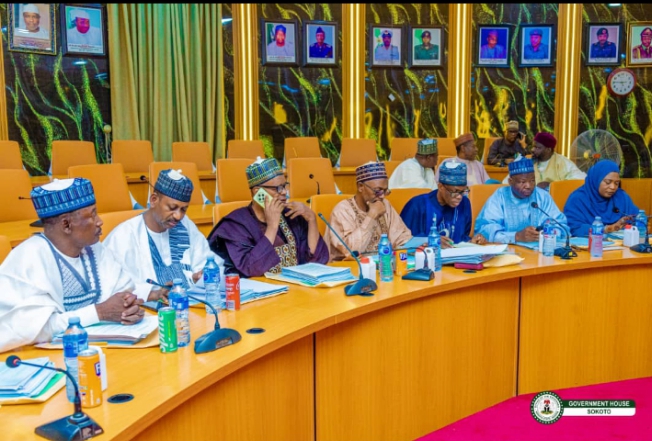
It is worth noting, too, that this security push is not happening in isolation from Governor Aliyu’s broader developmental agenda. The same Executive Council meeting had approved major investments in education, from the renovation of Government Science Secondary School, Gwadabawa, to the transformation of Shehu Shagari College of Education into a dual-mandate institution capable of awarding both NCE and degree certificates, to library equipment for Shehu Shagari University of Education and infrastructure works at Idris Koko Technical College as well as Ahmadu Bello Academy. This is the mark of a government thinking in parallel tracks, to secure the present while building the future.
A state cannot educate children who are afraid to walk to school, and it cannot attract the investment its young people deserve without first restoring the confidence that comes with safety.
Governor Aliyu’s approach to Sokoto’s security challenge deserves recognition precisely because it has been sustained rather than episodic. Bandits do not respect half-measures, and communities living in the climate of terror do not need occasional gestures, but need governments willing to leave no stone unturned.
From armoured vehicles to legislative reform, from operational vans to prosecutorial tools, this administration is assembling every instrument available to reclaim Sokoto State from criminal elements.
For the ordinary farmer who can now consider returning to abandoned farmland, for the trader who can move goods along once-dangerous highways, and for the parent who can send a child to school without dread, Governor Aliyu’s security investments are not abstract budget figures, they are indeed the difference between fear and hope.
Sokoto State is fortunate to have a leader unafraid to spend what it takes to secure its people.
Lawal Jet Kaugama, a commentator on national issues, writes from Kano. He can be reached on [email protected]