

The announcement by Sokoto State Governor, Ahmad Aliyu Sokoto, on the introduction of new initiatives to curb banditry marks a significant moment in the state’s long and arduous struggle against insecurity. Coming at a time when many communities are yearning for lasting peace, the Governor’s
Category: Opinions

Drainages :Timely lifeline for Jigawa communities
The recent approval of over ₦4.88 billion by the Jigawa State Government for the construction of drainages across selected local government areas stands as a clear demonstration of responsive, people-centred leadership under Governor Umar Namadi.
At a time when

Sen. Abdulaziz Yari and the power of cultural bridges
In a nation often strained by ethnic suspicion and regional divides, moments of genuine cultural harmony deserve more than passing applause, they deserve reflection. One such moment unfolded on Sunday in the ancient city of Oyo,

Engr Danjuma Abdullahi Ijala: A beacon of innovation and service honoured with D.Sc.
The nomination and approval of Engr. Danjuma Abdullahi Ijala for the conferment of an Honorary Doctor of Science (D.Sc.) degree by the Federal University Otuoke, Bayelsa State, stands not only as a personal milestone but also as a collective triumph for his family

Gov Namadi’s financial strategy: Why Jigawa needs facts not fear mongering
The recent uproar over an alleged ₦135 billion debt attributed to the administration of Governor Umar Namadi has sparked unnecessary tension within the Jigawa State chapter of the All Progressives Congress (APC). While healthy political discourse is welcomed in any democracy, it

Why linking Otti’s visit to Nnamdi Kanu to Gov Ahmed Aliyu is a mere political propaganda
The recent press release issued by Abubakar Bawa, Director General, Media and Publicity to the Governor of Sokoto State, offers not only a clarification of events

Gov Umar Namadi’s fearless blueprint for jigawa’s future
In an era when many states grapple with indecision, bureaucratic inertia, and policy half-measures, Jigawa State stands out, once again, under the bold, visionary, and uncompromising leadership of His Excellency Malam Umar A. Nama

Disregard this manufactured outrage over Jigawa’s Government House vehicles
The recent furore generated by Sahara Reporters regarding alleged vehicle spending at the Jigawa State Government House is yet another example of how misinformation, political mischief, and selective outrage are weaponised to undermine genuine leadership. Their narrative, laden with sensationalism and driven by anonymous whispers, is less an act of journalism and more a carefully choreographed hatchet job orchestrated by political godfathers who remain deeply uncomfortable with Gov Umar Namadi’s rising profile and his refusal to dance to their tune.
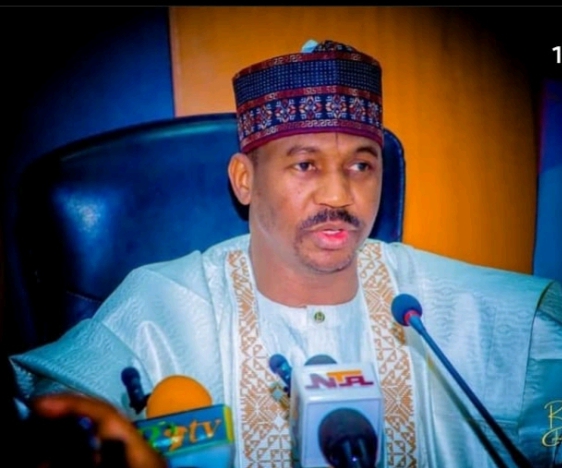
Gov. Ahmed Aliyu’s solar-powered water project a lifeline for Sokoto
Across Nigeria today, one of the most persistent challenges facing urban and rural communities alike is access to clean, reliable, and affordable water. The crisis is often tied to an unreliable power supply, which cripples water agencies from pumping water consistently. In states where electricity failures are routine, water scarcity becomes a daily reality for millions of citizens. It is within this national context that Governor Ahmed Aliyu’s bold investment in a 4.2-megawatt solar power plant for the Sokoto State Water Board stands out—not just as another government project, but as a transformative intervention with far-reaching impact.
The newly launched solar plant now under construction at the Sokoto State Water Board is more than an infrastructure upgrade; it is a strategic, forward-looking commitment to solving a problem that has frustrated generations. Commissioner for Petroleum and Energy Resources, Sanusi Ibrahim Dan Fulani, captured the essence of the initiative when he described it as one of many efforts by Governor Ahmed Aliyu to improve the welfare of the people. Indeed, water is not simply a social amenity. Water is life. It is health, dignity, economic productivity, and human survival. By securing the energy needed to pump potable water to residents, Governor Aliyu is improving all these at once.
For decades, the Sokoto metropolis—like many urban centres across Nigeria—has suffered from inconsistent water supply, largely due to erratic electricity. The Sokoto Water Board could not pump at optimal capacity, leading to rationing, long waits, and in many cases, complete outages in parts of the city. With the 4.2-megawatt solar plant, that cycle of dependence on unstable grid power is coming to an end. The decision to switch to renewable energy is not only innovative but economically wise. Solar power guarantees uninterrupted energy, reduces long-term operating costs, and shields the water sector from the unpredictable fluctuations of the national grid.
The General Manager of the Sokoto State Water Board, Engineer Aminu Haruna Mika’ilu, reaffirmed that the project, once completed, will permanently solve the power challenges that have hindered water pumping. This is an extraordinary step forward for a state capital that has grown in population and demand over the years. With this move, Governor Aliyu is not merely addressing a problem—he is building a sustainable system for the future.
What makes the governor’s action especially commendable is his understanding of infrastructure interdependence. Many leaders focus on launching water projects without considering the energy that powers them. Governor Aliyu has taken a different approach: tackling the power problem at the source so that the water system can function seamlessly. This is the kind of systemic thinking Nigeria desperately needs.
His administration’s parallel investment in re-electrification projects across Sokoto East Senatorial District reinforces the same philosophy of sustainability. As Commissioner Dan Fulani appealed to residents to pay their electricity bills for uninterrupted supply, it became clear that the state is not just replacing wires and poles—it is rebuilding trust and accountability within the energy ecosystem.
But the larger story here is leadership foresight. Nigeria’s water crisis is fundamentally an energy crisis. By choosing solar, Governor Aliyu is aligning Sokoto State with global best practices. Solar-powered water systems have proven to be one of the most cost-effective ways to guarantee potable water in developing regions. They minimize operational costs, eliminate fuel dependency, reduce carbon emissions, and ensure round-the-clock availability.
For Sokoto, a state blessed with abundant sunlight, the project is both logical and visionary. It signals that the administration is not content with short-term fixes. Instead, Governor Aliyu is investing in infrastructure that will serve the people for decades. This is governance driven by science, sustainability, and em

Gov Abba Kabir Yusuf’s bold step on Mathematics teachers recruitment signals a new dawn for Kano’s education future
At a time when Nigeria grapples with dwindling student performance in core science subjects, Kano State has taken a decisive step that deserves both commendation and emulation. Governor Abba Kabir Yusuf’s approval and formal presentation of appointment letters to 400 newly recruited Mathematics teachers is more than an employment gesture—it is a strategic investment in the intellectual future of Kano State. It is a clear demonstration of foresight, vision, and a deep understanding of what truly drives development in the 21st century.
Mathematics, often regarded