
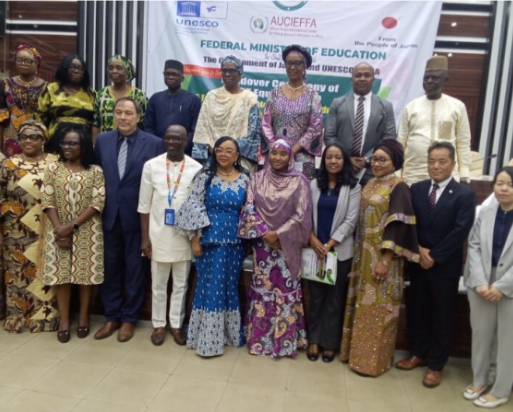
FG hands over Japan suppoted ICT equipment to 15 COEs nationwide
By Uji A Iliyasu, Abuja
The Federal Government has handed over Information and Communication Technology (ICT) equipment and materials to 15 Colleges of Education across Nigeria as part of efforts to strengthen teacher education and promote digital learning.
Speaking at the official handover ceremony in Abuja, Tuesday, the Minister of State for Education, Professor Suwaiba Said Ahmad, described the intervention as a significant contribution by the Government of Japan through UNESCO’s International Institute for Capacity Building in Africa (IICBA).
She said the initiative aligns with the Federal Ministry of Education’s priorities under the Renewed Hope Agenda.
The Minister said, the donation forms part of the project titled, “Capacity-building of Teachers to Promote Continuous and Inclusive Access to Safe and Quality Education for Girls in West Africa,” launched in March 2024, by UNESCO-IICBA in collaboration with the Government of Japan and the African Union.
She noted that the project covers six countries—Burkina Faso, Cameroon, Chad, Mali, Mauritania, and Nigeria, and is designed to strengthen teacher training institutions and improve equitable access to education, particularly for girls.
Professor Ahmad emphasized that teachers remain the foundation of any successful education system, adding that the ICT equipment would enhance both pre-service and in-service teacher training through improved access to digital learning resources and innovative teaching methods.
The donated items include 65 laptop computers, 71 tablets, four desktop computers, five interactive smart boards, 19 all-in-one desktop computers, 14 projectors, 15 printers, and 15 backup hard drives.
She said the equipment would improve teaching and learning experiences in the beneficiary institutions while helping to produce digitally competent teachers capable of meeting 21st-century educational demands.
The minister also highlighted that the event includes consultations and training on safe school learning environments, infrastructure security, and the use of ICT for inclusive and gender-responsive teaching.
She stressed that safe and secure schools remain critical to achieving quality education, especially for girls and vulnerable learners.
Reaffirming the ministry’s commitment to educational development, Professor Ahmad identified TVET, STEM, out-of-school children education, girl-child education, quality assurance, and data digitization as key priority areas.
She further disclosed ongoing initiatives focused on empowering female teachers and school leaders in crisis situations through mobile-based learning and integrating out-of-school children into formal education.
The minister expressed appreciation to UNESCO-IICBA, the Government of Japan, the African Union, and other development partners for their support and urged beneficiary institutions to utilize the equipment effectively to improve learning outcomes and strengthen teacher education across the country.