
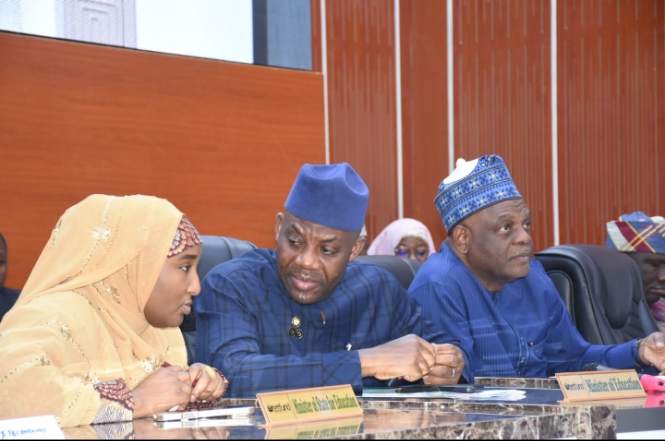
FG inaugurates committee to drive hands-on engineering education
By Uji A Iliyasu, Abuja
The Federal Government has taken a major step towards repositioning engineering and technology education with the inauguration of a Ministerial Monitoring, Evaluation and Implementation Committee for a special high-impact intervention project aimed at transforming universities into hubs of practical training, innovation and applied research.
The intervention, being implemented in collaboration with the Tertiary Education Trust Fund (TETFund), is designed to bridge the long-standing gap between theoretical knowledge and practical competence among engineering and technology graduates.
The committee is chaired by the President of the Nigerian Society of Engineers (NSE), Engr. Ali Rabiu, and comprises eminent scholars, professionals and technocrats.
Inaugurating the committee in Abuja on Monday, the Minister of Education, Dr Tunji Alausa, described the initiative as a critical milestone in the Federal Government’s deliberate and strategic efforts to rebuild engineering and technology education as a driver of industrialisation, innovation and sustainable national development.
He noted that for years employers had expressed concern over the limited practical skills of many graduates, a situation he said had weakened industrial confidence and reduced Nigeria’s competitiveness in the global technology space.
“For too long, concerns have been raised about the gap between theoretical knowledge and practical competence among our graduates. These gaps have limited employability, weakened industrial confidence and constrained our ability to compete in a fast-evolving global technology landscape,” he said.
Alausa explained that the TETFund Special Impact Intervention Project was deliberately structured to tackle the challenge through the provision of modern workshops, advanced laboratories, cutting-edge equipment and industry-relevant training environments.
He said the facilities will enable universities to produce graduates capable of designing, fabricating, testing and industrialising solutions.
He clarified that the intervention is separate from other allocations contained in TETFund’s 2026 disbursement guidelines, which earmarked about N20 billion for the upgrading of engineering workshops in selected universities.
The minister listed beneficiaries in the first phase to include federal universities of technology across the geopolitical zones, such as those in Akure, Owerri and Minna, as well as some conventional federal and state universities. He added that more institutions would be captured as the implementation progresses, while others were already benefitting from medical and science-based interventions.
On the committee’s mandate, Alausa said members would monitor the rehabilitation and equipping of engineering and technology workshops, ensure compliance with approved standards and recommend the construction of new workshops where necessary.
He added that the committee would also oversee the utilisation of funds in line with procurement laws and transparency principles, maintain digital project records, submit periodic reports and recommend sanctions for non-compliance.
Minister of State for Education, Prof. Suwaiba Said Ahmad, described the intervention as strategic to Nigeria’s quest for industrialisation, innovation and sustainable economic growth.
She stressed that funding alone could not guarantee impact, emphasising the need for effective implementation, strict adherence to standards, transparency and accountability.
In his remarks, the Executive Secretary of TETFund, Sonny Echono, commended the initiative and acknowledged the roles played by the President and the National Assembly in mandating deliberate efforts to restore Nigerian universities to global competitiveness.
“I have no doubt that this committee, made up of eminent Nigerians and professionals, will help in identifying needs, specifying priorities, monitoring implementation and ensuring that the funds allocated are prudently and judiciously utilised,” he said.
The inauguration is widely seen as a significant move to align university training with industry needs and position Nigeria’s engineering and technology sector for global relevance.