
By Lawal Jet Kaugama
Leadership is often measured by how policies, projects and official pronouncements are executed. But there is another, quieter dimension of leadership that becomes most visible when families experience grief. The ability to stand with people when there is nothing to offer except sympathy, prayers and human presence is a rare schedule of public officeholders, which
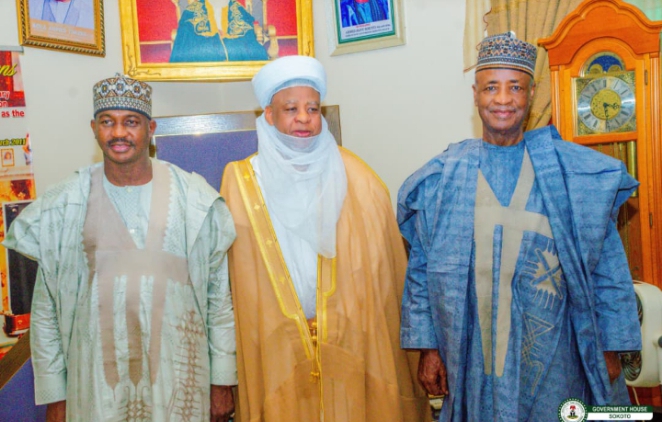
was the spirit behind Sokoto State Governor, Ahmed Aliyu’s condolence visit to the Sultan of Sokoto, His Eminence Muhammad Sa’ad Abubakar III, following the death of the Sultan’s stepmother, Hajiya Nana Asma’u, who died at the age of 100.
The visit, according to the Director General, Media and Publicity, Government House, Sokoto, Abubakar Bawa, was more than a routine official engagement. It was an expression of solidarity with the Sultan and the royal family at a moment of profound loss.
Governor Aliyu did not approach the occasion with the language of politics. He approached it as a fellow human being sharing the grief of another human being.
Describing the death of Hajiya Nana Asma’u as a great loss to the royal family, Sokoto State and the country, the governor acknowledged the important motherly role she played within the royal household.
His message was simple but profound: bereavement is part of the human journey, and those left behind must find strength in the knowledge that life and death ultimately remain in the hands of Almighty Allah.
By personally visiting the Sultan, Governor Aliyu demonstrated something that public office can sometimes make easy to forget, that behind every title is a human being who experiences joy, pain, loss and grief.
The significance of the gesture is heightened by the position occupied by the Sultan of Sokoto. As the traditional and Islamic leader of the Sokoto Caliphate, the Sultan occupies a unique place in the social, cultural and religious life of the people. Showing solidarity with him in a moment of personal bereavement therefore, carried both personal and institutional significance.
It also reinforced the value of mutual respect between elected political leadership and traditional institutions.
Governor Aliyu’s condolence was not limited to words. He made the journey to the Sultanate and was accompanied by a broad delegation comprising the State All Progressive Congress (APC) Leader, Senator Aliyu Magatakarda Wamakko; State APC Chairman, Haruna Adiya; members of the legislature; commissioners; APC Zonal Secretary Isah Saddiq Achida; Special Advisers, Senior Special Assistants and other political associates.
The governor’s decision to personally lead the delegation sent a clear message about the seriousness with which he regarded the loss.
The response of the Sultan was equally significant. His Eminence thanked Governor Aliyu for the condolence visit and prayed to Almighty Allah to reward him abundantly. He further prayed that the governor would live long to continue serving humanity.
That exchange captured the essence of the occasion. It was not about political differences or partisan interests. It was about compassion, respect and prayer.
Perhaps even more revealing was what happened after the governor left the bereaved family.
Governor Aliyu proceeded to visit other bereaved families in Sokoto metropolis. Among them were the families of Abdullahi Kafinta, Malam Abdullah Na Hali, late Malama Aminatu Shehu, Aisha Umar, Abubakar Abdulraheem and Alhaji Garba Shugaba, as well as the families of Ahmad Mode and late Aliyu Musa Mana.
The ages of some of those who died were striking. The governor visited families mourning people who lived into their eighties and nineties, while the death of Malama Aminatu Shehu at the reported age of 117 represented the passing of a remarkably long life.
The governor’s visits to these families are important because they demonstrate that his condolence was not reserved for the royal household. The same message of sympathy was extended to families across different parts of the metropolis.
At each location, prayers were offered for the repose of the souls of the deceased.
This is perhaps the most compelling aspect of Governor Aliyu’s conduct on the day. He demonstrated solidarity not only through public statements but through physical presence.
For bereaved families, such presence can be deeply meaningful. No political office can reverse death, and no government pronouncement can immediately remove the pain of losing a loved one. But a leader can stand beside the grieving, offer prayers and remind them that they are not alone.
The account signed by the Director General, Media and Publicity, Government House, Sokoto, Abubakar Bawa, presents a picture of leadership rooted in personal engagement and empathy.

In this era when public officials are sometimes perceived as distant from ordinary citizens, moments such as these provide a different picture of public service, one in which leadership involves sharing both the responsibilities and the emotional realities of the community. Governor Aliyu’s condolence visit to the Sultan should therefore, be viewed within that broader context.
The governor did not merely visit a palace. He visited a grieving family to share in their grief. He did not merely issue a statement, he offered his presence. And he did not stop with the state’s foremost traditional institution; he extended the same gesture of sympathy to other bereaved families.
That is leadership beyond the office.
As Sokoto mourns Hajiya Nana Asma’u and other departed citizens, the most appropriate response remains prayer.
May Almighty Allah forgive their shortcomings, accept their good deeds and grant them eternal rest in Jannatu Firdaus. May He also grant the Sultan, the royal family and all the bereaved families the strength and patience to bear their losses.
In moments of grief, leadership is not always about what a leader can do, for instance, sending money and gifts to the bereaved Sometimes, it is simply about being there for the people in their hour of grief. Governor Aliyu, therefore, has demonstrated this beyond all doubt that the visits were not politically inspired, but by the humanity in him.
Lawal Jet Kaugama is a commentator on national issues. He writes from Kano