
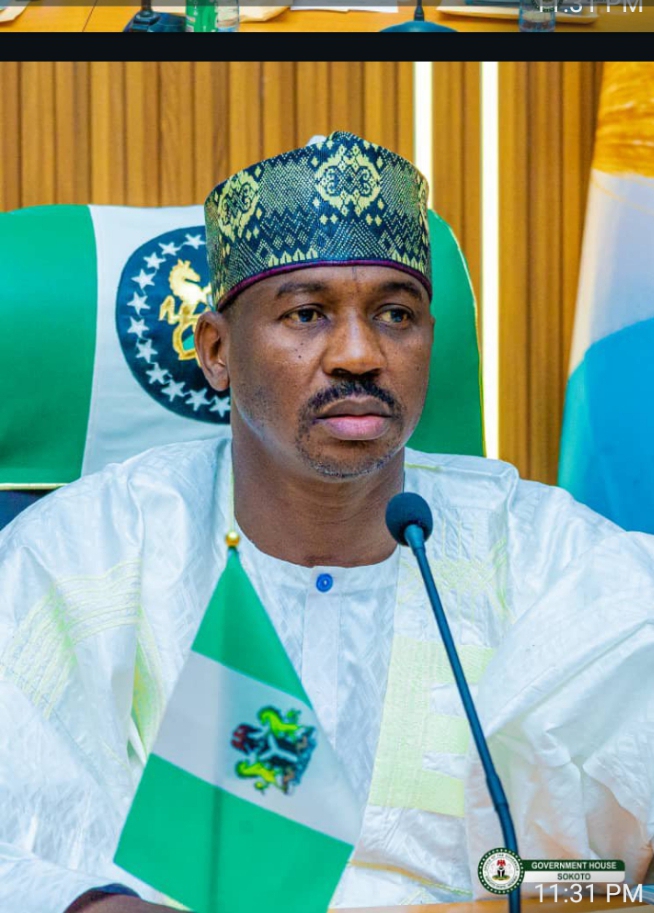
Gov Ahmed Aliyu: Sokoto have listened to you and believed in you
By Lawal Jet Kaugama
In Nigerian public life, the distance between a promise made and a promise kept is often wide enough to swallow whole communities. Politicians pledge at podiums and forget in their offices. Victims of disasters are visited, photographed, consoled and then left to their funeral. It is, therefore, worth pausing to acknowledge a leader who closes that distance, and in Sokoto State, Governor Ahmed Aliyu has just done so.
Last Friday, 9 October, while receiving the report of the committee he set up to investigate the fire outbreaks at Sokoto Old Market and the Central Motor Park, the governor pledged financial assistance to the affected traders so they could resume their businesses.
Barely days later, that pledge has become a reality. The sum of N143 million has been disbursed to 76 traders verified as genuine victims.
There was no prolonged silence and no bureaucratic fog. A promise was made, and a promise was redeemed.To appreciate the weight of this gesture, one must recall what the fires took.
In July, parts of the Central Motor Park and the Old Market were gutted, disrupting commercial activities at two of the state’s busiest economic hubs. For the trader, a market stall is not a mere business address. It is the school fees of children, the feeding of extended families, and the dignity of self-reliance.
When fire consumes the stall, it consumes a household’s entire security overnight. Many who depend on such markets for their daily income have no savings or insurance to fall back on. For them, government’s response is the difference between recovery and ruin.
What makes the governor’s response commendable is not only its speed but its method. He did not simply announce a figure and hand out cash. He constituted a nine-member committee to investigate the two separate incidents, assess the extent of the damage and determine how many traders were truly affected.
The committee carried out a thorough verification exercise and confirmed that only 76 of the 94 claimants were genuine victims.This matters. In a country where public funds are too often lost to inflated lists and opportunistic claims, the insistence on verification is itself a form of integrity. It shows a government that respects the money entrusted to it, and that wants help to reach those who truly suffered rather than those who merely learned to queue.
Generosity without accountability is waste, and accountability without generosity is cold bureaucracy.
Governor Aliyu has combined both.The committee’s chairman, Barrister Gandi Umar Muhammad, captured the spirit of the exercise when he explained that the money was not compensation but a gesture of support to help the traders revive their businesses.
This is a mature and honest framing. No government can fully compensate a trader for years of accumulated stock, goodwill and effort lost to flames. What a responsible government can do is extend a hand, give people a fighting spirit to rebuild, and show that their suffering did not go unnoticed.
That is precisely what has been done.
The highest beneficiary received N25 million, while others received amounts proportionate to their losses, a fair principle that rewards neither favouritism nor flattery.
It would also be a mistake to treat this as an isolated act of kindness. According to the statement issued by the Director-General, Media and Publicity, Government House, Sokoto, Abubakar Bawa, the Sokoto State Government has extended similar assistance to victims of market fire disasters across the state since the inception of the Aliyu administration.
Mechanics in the Buzaye area and traders at Kara Market are among those who have benefited. A single act of generosity can be a political calculation, but a consistent pattern reveals character. It tells us that care for citizens in distress is not a seasonal gesture in this administration, but a settled principle of governance.
The traders themselves have spoken, expressing gratitude and noting that the support will go a long way in helping them restart their businesses. Their testimony deserves more weight than any commentator’s praise, because they are the ones who bore the loss and now feel the relief.Why does all this matter beyond Sokoto? Because trust is the most valuable currency in governance, and it is built as one keeps a promise at a time.
Citizens do not trust leaders because of manifestos, slogans or well-crafted speeches. They trust leaders whose words and actions align, who say what they will do and then do it.
Every redeemed pledge makes the next promise more believable, and every broken one makes the next more doubtful.
A government that keeps its word earns the right to be heard when it asks for patience, cooperation and sacrifice for the larger public good.Nigeria’s democracy is starved of this kind of reliability. Our people have grown so accustomed to unfulfilled pledges that a kept promise now feels remarkable, when it should be ordinary.
Perhaps the most important thing this episode does is restore a little faith that public office can still mean public service.
Governor Aliyu, therefore, deserves commendation for this, and the people of Sokoto State deserve to take comfort from it. He heard the cry of struggling traders, verified their claims, honoured his word and moved on to the work of rebuilding.
Leaders who behave this way are not asking for applause, but they have certainly earned our trust.As the traders return to rebuild their stalls and restock their shelves, they carry something more valuable than the money itself: the knowledge that their government saw them, listened to them and kept its word. That is what good governance looks like, and it is a standard worth holding up for others to follow.
Credit is also due to the Director-General, Media and Publicity, Government House, Sokoto, Abubakar Bawa, whose prompt and clear communication ensured that the public was properly informed of this gesture.
In an age when government actions often go unreported or misreported, such diligence in keeping citizens informed is itself a service to the state.
To Governor Aliyu, the people have heard you and believed in you. keep it up.
Lawal Jet Kaugama, a commentator on national issues, writes from Kano. He can be reached on [email protected]