
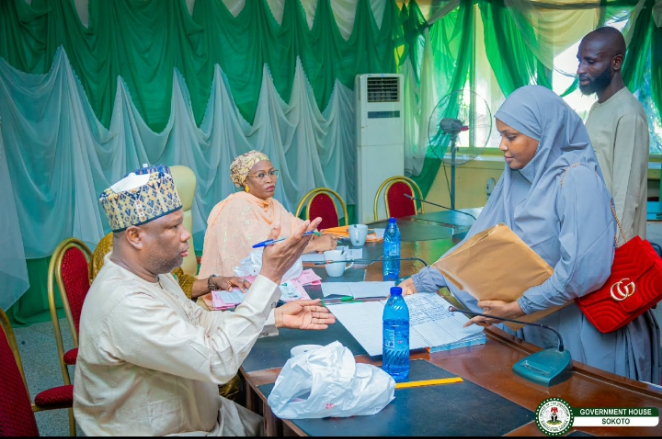
Gov Ahmed Aliyu: strengthening security by reducing unemployment
By Lawal Jet Kaugama
Governments are remembered less for the promises they make than for the lives they change. In Sokoto State, Governor Ahmed Aliyu’s administration is building a record on the most important foundation of all, which is its people.
Credit is due to Director General, Media and Publicity, Sokoto State Government,
Abubakar Bawa, for keeping the public informed about this progress. His latest statement announced that the state has commenced payment of salaries to 3,100 newly recruited workers into the civil service. Behind that figure are 3,100 families whose circumstances have changed.
The process deserves attention. The payment was flagged off by the Head of the Sokoto State Civil Service, Abdulkadir Ahmed, at the Cabinet Office, following a verification exercise to confirm that the new recruits had reported to the ministries, departments and agencies where they were posted.
This matters. It shows a government that recruits with purpose and insists on accountability, rather than adding names to a payroll without regard for service delivery.
The recruitment also fulfils a campaign promise. Governor Aliyu pledged to provide employment opportunities for the state’s teeming unemployed population, and the evidence of delivery is now on record.
In a political culture where promises made on the campaign trail are too often forgotten after the votes are counted, a leader who keeps his word has earned recognition.
The 3,100 workers form part of a larger story. Within three years, the administration has employed over 8,000 workers across various sectors. The health sector accounts for 1,805 of them, comprising 1,500 nurses and midwives, 175 doctors, 45 pharmacists, and 85 radiographers and other health professionals. These are not mere numbers.
A midwife in a rural clinic can mean a safe delivery. A doctor in a general hospital can mean a life saved. A healthy population is the bedrock of every other development goal, and strengthening the health workforce is human capital development in its most direct form.
Security has not been neglected. The recruitment of 2,747 personnel into the Sokoto State Community Guard Corps, together with the recent engagement of 1,550 personnel by the Sokoto State Marshal, reflects an understanding that communities cannot prosper where they feel unsafe. By drawing on local people to protect their own communities, the administration is pairing employment with security, two urgent needs addressed through one approach.
Equally commendable is the manner in which these recruitments were conducted. They were carried out irrespective of the applicants’ political affiliations, giving every qualified indigene an equal opportunity to participate.

In Nigeria where public jobs are sometimes viewed as rewards for loyalty, this is a welcome departure. It tells young people in Sokoto that competence and eligibility count for more than connections, and it strengthens public trust in government institutions.
The administration’s vision also reaches beyond the civil service. Thousands of women and youths have been trained in different trades and supported with equipment and take-off grants to establish their own businesses. This is a wise complement to public-sector hiring, because no government can employ everyone. The sustainable path is to equip citizens to create opportunities for themselves and for others.
A woman who learns a trade and receives start-up support earns an income, but she may also employ others, train apprentices and stimulate her local economy. Multiplied across thousands of beneficiaries, the effect on livelihoods is considerable.
Taken together, these initiatives reveal a coherent philosophy: jobs in the public service, a stronger health workforce, community-based security, and skills and enterprise support for women and youths. They share a single aim, which is to expand the capacity of Sokoto’s people to live productive, dignified and self-reliant lives.
That is what human capital development means in practice. Roads and buildings age, but a skilled, healthy and gainfully employed population compounds its gains across generations. This is the kind of legacy that outlasts any single term of office.
The Head of Service rightly urged the new recruits to be punctual, dedicated and committed to their duties. The beneficiaries, for their part, have expressed gratitude and promised to discharge their responsibilities diligently.
The task ahead is to convert opportunity into performance. A motivated and regularly paid workforce is the engine of effective public service, and those who have been given this chance owe it to the state to justify the confidence placed in them.
Governor Aliyu has shown that governance, at its best, is an act of service. His administration’s focus on employment, health, security and empowerment offers a model that other states would do well to study.
History tends to remember leaders who invested in people, and the people of Sokoto State are better positioned today because of those investments.
The administration deserves commendation for what it has done, and encouragement to sustain this direction. A state that invests in its people invests in its own future.
Lawal Jet Kaugama, a commentator on national issues, writes from Kano. He can be reached on [email protected]