
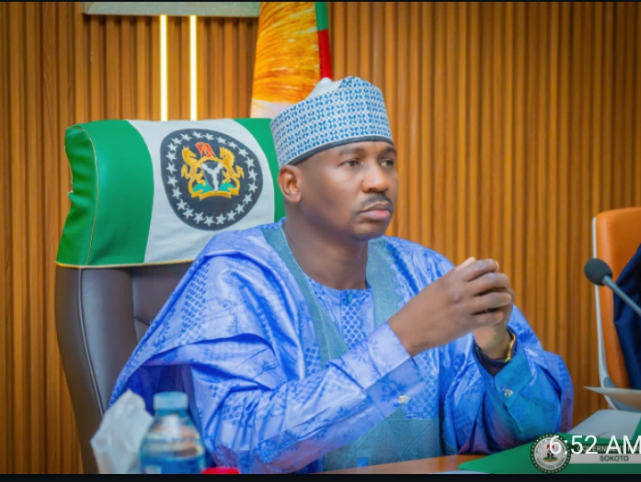
Gov Aliyu: Sokoto’s development index on steady rise
By Lawal Jet Kaugama
Governance is judged by what citizens can see, touch and use. A road that shortens a journey, a borehole that ends a long walk for water, a hospital ward that is finally renovated, a classroom that no longer leaks: these are the true measures of an administration.
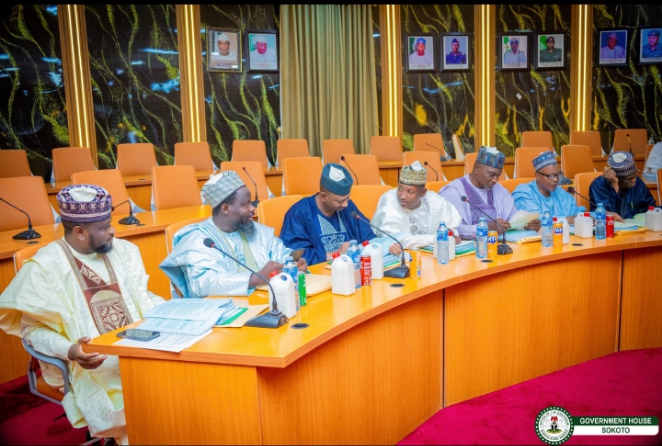
By that standard, the 9th regular meeting of the Sokoto State Executive Council for 2026, chaired by Governor Ahmed Aliyu, deserves commendation.
According to a statement signed Saturday by Abubakar Bawa, Director-General, Media and Publicity, Government House, , the Council approved a basket of projects that, taken together, comes to nearly N34 billion. What stands out is the range.
The approvals cover roads, water, health, education, security infrastructure and religious affairs, which are the areas where ordinary people feel government most directly.
Start with infrastructure. The Council approved N10.96 billion for 11 clusters of roads, with reinforced concrete and outfall drains, in the Arkilla Federal and State Low-Cost area of Sokoto metropolis. The inclusion of drainage is the mark of serious planning. Anyone who has watched a good road crumble after one rainy season knows that pavement without proper drainage is money poorly spent. Reinforced concrete and outfall drains point to durability, not cosmetic fixes.
The proposed dual carriageway from Tsehen Masu through New City Kwasai to the old airport runway, at N8.54 billion, is commercially promising.
Cities grow along their arteries. A dual carriageway on that corridor will ease congestion, open up land for housing and commerce, and connect communities to the economic heart of the state.
Added to it are the roads off Kaduna Road and Tsafe Road, the cluster in Guiwa, and the rehabilitation of Bunza Road, at N1.79 billion. Together they show a government attending to both major corridors and neighbourhood streets.
On water, the approval of 200 fully equipped semi-urban solar-powered boreholes across all 23 local government areas, at N7.84 billion, may prove the most consequential decision of the meeting. Access to safe water is a public health issue, an education issue and a gender issue. When water is far away, it is usually women and girls who walk to fetch it, and the hours lost are hours taken from school and productive work.
Choosing solar power also shows sound judgement, since it avoids the recurring fuel costs and breakdowns that have killed many water schemes elsewhere. The further N249.4 million for drilling materials, submersible pumps and accessories for rural water schemes recognises that building is only half the work; maintenance keeps projects alive.
The health approvals show the same practical sense. Renovating the General Hospitals in Tureta and Rabah, re-awarding and completing the General Hospital in Dange, and renovating primary health centres at Badon Barade and Alu Quarters, Mana, with a perimeter fence for the latter, strengthens the system from the grassroots upward.
Primary health centres are the first point of contact for most families, and a functioning one can prevent a minor illness from becoming an emergency. Strengthening general hospitals gives those centres a dependable referral network.
In education, the Council approved N492.4 million to renovate the collapsed and dilapidated hall at Umaru Ali Shinkafi Polytechnic; N99.9 million for teaching and learning equipment at Shehu Shagari University of Education; and N911.6 million for the renovation of Government Girls Commercial Secondary School, Tambuwal.
Education changes the trajectory of a society, and the focus on girls’ schooling is especially welcome in a region where keeping the girl-child in school remains an urgent challenge. A decent, safe school building is often what persuades a family to keep a daughter in class.
The approvals for religious affairs also reflect an understanding of the people Governor Aliyu serves. The renovation of the central mosque at Shehu Shagari College of Education, the completion of the Sultan Sa’ad Abubakar Jumu’at Mosque in Guiwa, the renovation of Tangaza Central Jumu’at Mosque, the remodelling of the mosque at the Police Zone 10 office and the completion of Izala Jumu’at Mosque in Isa, all serve communities for whom faith is central to daily life. 6Governing a diverse society well means respecting its values, and these approvals do so evenhandedly. Other decisions deserve mention too.
Procuring operational gadgets to protect government infrastructure, at N84.4 million, is a sensible way to guard public assets, and the office complex and shops for Caliphate Air Limited at the Sultan Abubakar III International Airport, at N178.3 million, support a growing commercial and transport hub.
Approvals alone do not build roads or drill boreholes. The real test of this meeting will be execution: timely mobilisation of contractors, strict quality control and transparent supervision. Citizens will rightly expect to see these projects delivered on schedule and to specification.
The Governor’s record of deliberate, council-driven decision-making gives reason for optimism, and the public documentation of these approvals through the Government House media office sets a standard of openness that invites accountability.
Credit is due to Governor Aliyu for leading a Council that plans across sectors, and to Abubakar Bawa and his team for keeping the public informed. If these projects are delivered as¹11 approved, Sokoto will have more than a list of figures to show for this meeting. It will have better roads, cleaner water, stronger hospitals, safer schools and renewed places of worship, and that is what good governance is meant to produce.
Lawal Jet Kaugama, a commentator on national issues, writes from Kano. He can be reached on [email protected]