
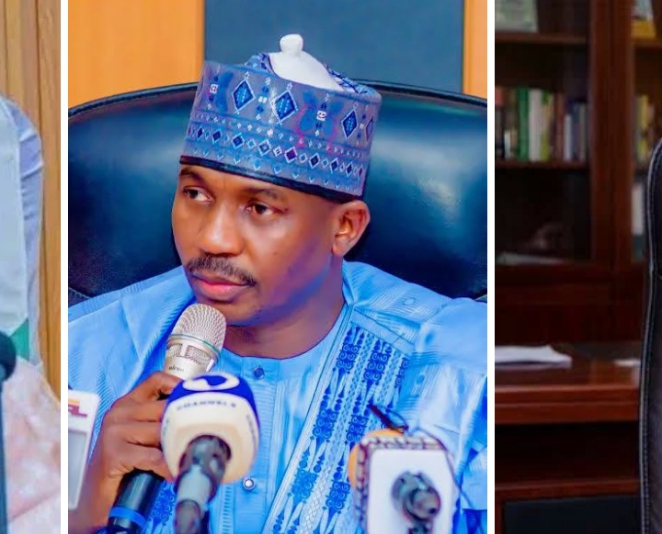
Gov Aliyu,’s tolerance and unbiased treatment of Islamic sects and non-Muslims
By Lawal Jet Kaugama
In Nigeria religion often becomes fault line rather than foundation. The manner in which a leader manages the spiritual affairs of a deeply religious society speaks louder than any political party manifesto.
In Sokoto State, seat of the historic Caliphate, and spiritual heartland of Islamic scholarship in Nigeria, Gov Aliyu has, since assuming office, demonstrated a rare and deliberate commitment to religious even-handedness, one that neither privileges a single strand of Islamic thought nor turns a blind eye to the concerns of those outside the Muslim majority.
This balance is not accidental. It is the product of a governor who appears to understand, perhaps more instinctively than many of his predecessors, that Sokoto’s peace has always rested on its ability to hold multiple religious currents in respectful tension rather than forced uniformity.
Consider the breadth of the administration’s engagement with religious bodies. The government’s support has not been confined to a single school of thought or a favoured congregation. From the renovation of over sixty mosques across the state, to the restoration of long-suspended allowances for Imams, deputy Imams and Muazzins, the reach of these interventions cuts across communities without regard to sectarian affiliation.
When the administration pledged to fully fund the annual Ramadan Tafseer organised by Izala groups, it did so not as a gesture of exclusive favour but as part of a broader pattern of support that has also extended to Sufi orders, traditional Jumu’at congregations, and the Sultanate establishment itself.
Few governors have managed to keep faith with such a wide spectrum of Islamic practice at once, and fewer still have done so without triggering the kind of sectarian resentment that so often follows lopsided patronage.
Equally instructive is the governor’s posture toward those outside the Islamic fold. In his engagements with the Saudi Arabian Embassy on Islamic propagation, Governor Aliyu was careful to frame the objective not as conquest or conversion by pressure, but as correcting “negative perceptions” through education and understanding, an approach that speaks to persuasion rather than imposition.
This is a subtle but important distinction. A government genuinely committed to justice across belief systems does not seek to erase difference; it seeks to ensure that difference does not become the pretext for hostility or exclusion.
The administration’s revival of the Hisbah Corps, accompanied by an explicit warning against the “witch-hunt of innocent citizens,” reflects an awareness that religious enforcement, if left unchecked, can easily curdle into instruments of persecution against minorities and dissenters alike. That the governor chose to draw this line publicly, rather than leave it to inference, says much about his sense of proportion.
This same instinct for balance has been visible in the government’s handling of recent religious tensions in the metropolis, tensions that culminated tragically in the killing at the Musa Lukuwa Jumu’at Mosque in Mabera.
Rather than allow the incident to be adjudicated solely through security channels or, worse, left to the court of public sentiment, the administration moved swiftly to constitute a committee of ulamas, scholars drawn from within the Islamic tradition itself, to examine both the remote and immediate causes of the crisis. This is governance that recognises the limits of state power in matters of faith: that some conflicts are better understood and resolved through religious scholarship than through decree alone.
At the same time, the ordering of a full investigation into the killing, and the closure of the mosque pending that inquiry, signals that no invocation of religious sentiment, however fervent, places anyone above the law.
It is this dual posture, firm on justice, generous in tolerance, that has come to define Governor Aliyu’s approach to Sokoto’s spiritual life. He has expanded the state’s welfare architecture for religious leaders and worshippers of various persuasions, from feeding centres that grew from 130 to 155 across the state during Ramadan, to graveyard attendants newly placed on government payroll, while simultaneously insisting that peaceful coexistence remain non-negotiable.
In appealing to residents to desist from inciteful statements and reaffirming his commitment to protecting “the lives and property of every citizen,” irrespective of religious or social standing, the governor has articulated a vision of Sokoto in which piety and plurality are not adversaries but companions.
In a season when religious grievance can so easily be weaponised for political ends, Sokoto’s example under Governor Aliyu offers a modest but instructive lesson: that a leader’s neutrality needs not mean indifference, and that firmness in the face of injustice can coexist comfortably with genuine devotion to faith.
It is a balance many states across Nigeria’s religiously diverse landscape would do well to study.
Lawal Jet Kaugama is a commentator on national issues. He writes from Kano