
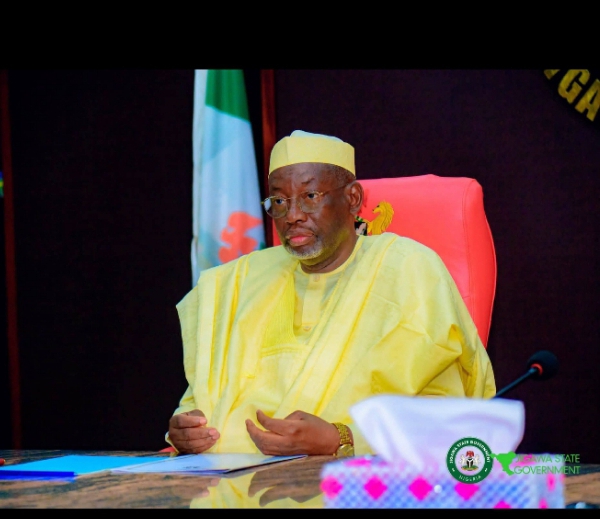
Gov Namadi’s local government development plans and his grassroots vision
By Lawal Jet Kaugama
Jigawa State governor, Umar Namadi’s administration is a leadership style that does not announce itself with fanfare, but with foresight. It is the kind that plants trees whose shade it may never sit under, builds roads it may not always trave on, and lays foundations whose full weight will only be felt by generations yet to come.
Gov Umar Namadi’s unveiling of the Local Government Development Plans (2025–2030) for all 27 Local Government Areas of Jigawa State belongs squarely in this tradition of quiet, deliberate statecraft.
At first glance, the event may have appeared modest, a policy launch, a signing, a photograph for the archives. But beneath its understated surface lies one of the most consequential governance interventions Jigawa State has undertaken in recent memory.
For the first time, every one of the state’s 27 councils now possesses a clear, structured, five-year roadmap tailored to its peculiar needs, aspirations and potentials. This is not governance by improvisation; it is governance by design.
Speaking at the unveiling, the governor was careful to situate the initiative within a longer arc of policy continuity, noting that it builds on earlier efforts such as the Local Government Economic Empowerment and Development Strategy. This detail matters.
Too often in Nigerian public administration, new administrations discard the work of their predecessors in favour of fresh initiatives bearing new names but little institutional memory. Namadi’s approach has been different: refine, modernise and institutionalise rather than discard and rebrand. That is the mark of a leader more interested in outcomes than optics.
What makes these plans genuinely significant is the process behind them. They emerged not from a closed policy room in Dutse, but from extensive consultations reaching into the state’s communities, its traditional institutions, its women and youth groups, and its civil society organisations.
Development plans crafted in isolation from the people they are meant to serve rarely survive contact with reality. Plans built through genuine consultation, however, carry within them the seeds of their own implementation, because the people who helped shape them have a stake in seeing them succeed.
Crucially, the plans are not freestanding documents disconnected from the broader machinery of state policy. Each is anchored on the administration’s 12-Point Agenda, the State Comprehensive Development Framework, and the Sustainable Development Goals. This alignment is what transforms the plans from aspirational wish-lists into instruments of coherent, measurable governance.
A council chairman implementing his local plan is, whether he fully realises it or not, simultaneously advancing state-level priorities and global development benchmarks. That is the kind of vertical integration that development economists spend careers advocating for, and Jigawa has now built it into the bones of its local government system.
Perhaps the most telling aspect of the governor’s remarks was his insistence that the true test of these plans lies not in their existence, but in their use. He has directed every council to treat them as the primary guide for budgets, workplans, projects and programmes, an instruction that, if faithfully observed, could fundamentally alter how public resources are allocated at the grassroots.
Too many strategy documents in Nigeria are launched with ceremony and then abandoned to gather dust in filing cabinets. Namadi’s explicit directive is a safeguard against that familiar fate, a reminder that a plan unused is merely paper, but a plan implemented is transformation.
It is worth pausing to appreciate the collaborative architecture behind this achievement: the Ministry for Local Government and Community Development, the 27 council chairmen, traditional rulers, and countless citizens who gave their time and voice to the consultative process.
Development of this scale is never the work of one office or one individual. It is the product of shared responsibility, precisely the ethos the governor invoked in his closing appeal to development partners, the private sector, and religious and traditional leaders to join hands in implementation.
History tends to be a fair judge of leadership, though rarely a swift one. The value of infrastructure, policy frameworks and institutional reforms is often only fully appreciated years after the officeholder who championed them has left the stage. In laying down these 27 development plans, each rooted in local realities yet harmonised with state and global priorities, Governor Namadi has done more than mark an administrative milestone. He has laid a foundation stone for Jigawa’s grassroots development, one whose true dividends will likely be harvested by communities long after the applause of the launch ceremony has faded.
Indeed, a public officeholder reveals his true character not through rhetoric, but through the plans he leaves behind for his people. On that measure, Jigawa’s Local Government Development Plans stand as a testament to a governor thinking not merely in electoral cycles, but in generations.
Lawal Jet Kaugama, a commentator on national issues, writes from Kano