
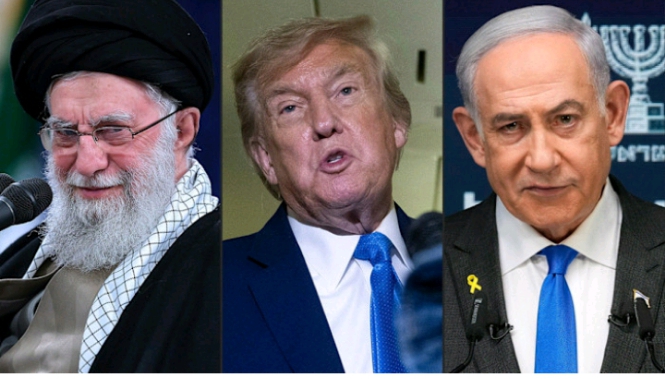
US-Israel vs Iran War: Why Iran is not Afraid
By Uji A. Iliyasu
Tensions between the U.S.–Israel vs Iran have been rising for years, driven by Iran’s nuclear and missile capabilities. Iran’s nuclear development and ballistic missile capabilities remain at the core of Western fears. The U.S. and Israel fear Tehran might achieve a breakthrough in nuclear weapons, especially as seen during the last year’s 12-day war with Israel/USA.
Axis of Resistance.
Iran’s regional influence through Hezbollah, Hamas, the Houthis, and other militias, often termed the “Axis of Resistance”, challenges both U.S. and Israeli strategic interests across the Middle East.
The 12-day war in June 2025 saw Israel and the U.S. attack Iranian nuclear facilities, and Iran responded with long-range missile and drone strikes on Israeli cities. Despite significant losses, Iran retained much of its missile arsenal and capacity to retaliate.
No to Trump’s Bullying.
President Trump has publicly warned Iran to negotiate a deal or face military action, deploying an aircraft carrier strike group and calling for Iran’s “unconditional surrender” on nuclear ambitions. Iran’s leadership, in contrast, has pledged immediate and intense retaliation to any attack.
Not Afraid of Trump and Allies.
Despite U.S.–Israeli combined military superiority, several factors explain why Iran’s leadership projects confidence and appears unafraid of Donald Trump and key allies:
Nationalism.
Iran’s rhetoric is shaped by internal politics.. The leadership portrays resistance to the U.S. as a source of national pride and legitimacy, especially amid severe domestic unrest and economic pressures. A show of defiance consolidates the regime’s standing and deters internal dissent.
Military Deterrent Capacity.
Though considerably outmatched in air power, Iran maintains a substantial arsenal of ballistic and cruise missiles, drones, and naval capabilities that can threaten U.S. bases, allies, and crucial infrastructure, including potentially disrupting shipping in the Strait of Hormuz, a global energy chokepoint.
This ability to inflict costly retaliation, even if asymmetrical, gives Tehran strategic leverage. Iran’s statements about being ready to respond “immediately and powerfully” emphasize deterrence rather than submission.
Fear of Regime Change.
Iran’s leadership sees submission under pressure as more dangerous than geopolitical conflict. Succumbing to U.S. demands could undermine the regime’s ideology and control. Thus, from its perspective, risking conflict may seem preferable to concessions that might invite domestic instability or challenge its theocratic authority.
Regional and Global Strategic Balances.
Iran’s alliances, whether formal or tacit, with powers like Russia provide important political cover and diplomatic support. Russia has publicly urged negotiations and warned against force, underscoring the risks of broader regional destabilization.
Major regional players.
Saudi Arabia, UAE, Qatar, Egypt also push for de-escalation to avoid catastrophic economic and security fallout, signaling that a violent confrontation could destabilize the wider Middle East.
Historical Resilience.
Iran’s leadership has long framed itself as a resistant state standing up to powerful adversaries. Since the 1979 Islamic Revolution and especially after the 2018 U.S. withdrawal from the Iran nuclear deal (JCPOA), Tehran has invested heavily in narratives of resistance and self-reliance, which in turn shape its foreign policy decisions.
Calculus of Trump and Allies.
Understanding why Iran feels emboldened also requires looking at American and Israeli strategies.
Trump’s approach, based on recent reporting, appears to favour limited strikes on nuclear infrastructure over direct regime change or prolonged occupation. This creates ambiguity rather than a clear existential threat to Iran’s leadership.
Domestic Constraints.
There is skepticism in the U.S. about another major Middle East war, given historical costs of Iraq and Afghanistan invasions. This limits Trump’s political space for full-scale war. Congressional and public support for war is not guaranteed.
Allied Hesitation.
Some U.S. regional partners are cautious about direct military involvement. Gulf states want stability and fear blowback from escalation. NATO allies historically offer political support but are wary of entering another Middle East combat zone.
Risk Remains High.
While rhetoric on both sides has grown harsh, experts caution that a full-scale U.S.–Israel vs Iran war is not inevitable. Some analysts describe Trump’s dramatic warnings more as political signaling than prelude to sustained military action.
Diplomatic channels.
Mediation efforts by Russia and Gulf states persist to prevent escalation.
The complexity of Iran’s response options (missiles, proxy networks, economic leverage via energy routes) creates huge costs for U.S.
policymakers weighing any attack.
Multilayered Tensions.
The confrontation between the U.S.- Israel vs Iran reflects deep, multi-layered geopolitical tensions, nuclear ambitions, regional influence, historical grievances, and domestic political imperatives. Iran’s posture of defiance stems from a blend of deterrence capability, regime-security priorities, and historical resistance narratives. Meanwhile, uncertainty in U.S. strategy, between symbolic threats and measured military options, has also shaped Tehran’s confidence that it can withstand confrontation without capitulation.
In all, Iran’s leadership fears loss of sovereignty and regime legitimacy far more than war itself, and this motivates it to take a hard line against Trump and his allies, even when confronted with combined superior military power. This dynamic fuels the risk of escalation, but does not guarantee outright war, especially given diplomatic efforts and complex global stakes.
Warning to Iran.
Iranian military should not relax their readiness to meet Trump. Like thieves in the night Trump and his allies are coming.
Dr Uji A Iliyasu, a commentator on national and global politics, writes from Abuja