
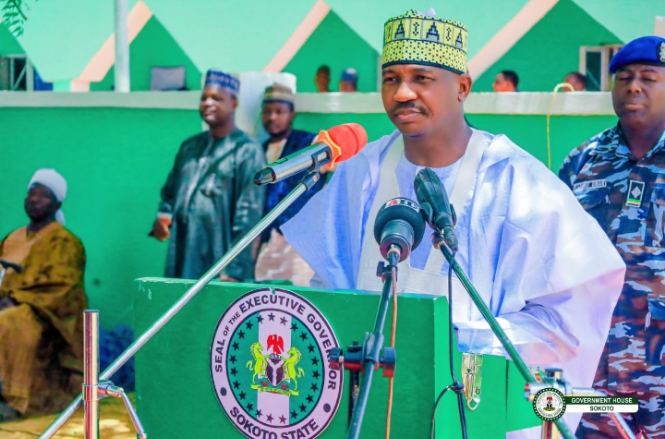
Why Gov Aliyu’s call to safeguard public projects is worth heeding
By Lawal Jet Kaugama
In Nigeria, public infrastructure is often treated as “nobody’s property,” therefore, the appeal by Gov Ahmed Aliyu Sokoto for citizens to safeguard government projects is both timely and necessary.
His message, delivered during the commissioning of the Kirare Izala Jumu’at Mosque in Goronyo Local Government Area, goes beyond a ceremonial statement, it reflects a deeper understanding of governance, sustainability, and civic responsibility.
At the heart of Gov Aliyu’s appeal is a simple but powerful truth: public projects are funded by taxpayers and are meant to serve the people. When such projects are vandalised, neglected, or misused, it is not the government alone that suffers, it is the entire community.
Schools deteriorate, roads become unsafe, and public facilities lose their value long before their intended lifespan. By urging residents to “guard all the projects executed by the State Government jealously,” the governor is effectively calling for a shift in public mindset, from indifference to ownership.
This approach deserves commendation because it recognises that governance does not end with project execution. Too often, leaders focus on commissioning projects without putting in place mechanisms for their maintenance and protection.
Gov Aliyu’s suggestion that communities establish local committees to monitor and safeguard these projects is both practical and forward-thinking. It empowers citizens at the grassroots level and fosters a sense of collective responsibility. When communities are directly involved in protecting what belongs to them, the likelihood of vandalism and neglect is significantly reduced.
Equally commendable is the governor’s emphasis on religious and educational development. The construction of the Kirare Izala Jumu’at Mosque, along with an Islamiyya school within its premises, highlights an integrated approach to community development, one that combines spiritual growth with intellectual advancement.
In many parts of northern Nigeria, mosques serve not only as places of worship but also as centres for learning, moral instruction, and social cohesion. By investing in such institutions, the Aliyu administration is strengthening the moral and educational fabric of society.
The Governor’s commitment to expanding Islamiyya schools and renovating cemeteries further underscores his sensitivity to the cultural and religious needs of the people. These are not merely symbolic projects; they address real needs within communities.
Islamiyya schools play a crucial role in shaping values, discipline, and identity among young people, while well-maintained cemeteries reflect dignity for the deceased and respect for tradition. In prioritising these areas, Gov Aliyu is demonstrating a leadership style that is both people-centred and culturally aware.
Another notable aspect of the event is the broad support expressed by key stakeholders. The endorsement by traditional and religious authorities, including Muhammad Sa’ad Abubakar III, represented by Prof. Sambo Wali Junaid, adds significant weight to the governor’s efforts.
In Sokoto State, where the Sultanate holds immense moral authority, such commendation signals alignment between the government and traditional institutions. This synergy is vital for effective governance, particularly in promoting initiatives that require community participation.
Similarly, the historical reference made by the Minister of State for Works, Bello Goronyo, linking Kirare village to the legacy of Usmanu Danfodiyo, adds a layer of cultural significance to the project. It situates the governor’s efforts within a broader historical and religious context, reinforcing the idea that development should respect and build upon local heritage.
It is also worth noting the administration’s attention to infrastructure, as highlighted by the construction of a road leading to Kirare village. Development is most impactful when it is holistic, when roads, schools, religious centres, and other facilities are developed in tandem.
The improvement of access roads not only enhances mobility but also stimulates economic activity and improves the overall quality of life for residents. However, while the governor’s appeal is laudable, its success ultimately depends on the response of the people.
Civic responsibility cannot be legislated; it must be cultivated. Communities must rise to the challenge by taking ownership of public assets, reporting acts of vandalism, and ensuring proper use of facilities. The proposed local committees, if properly implemented, could serve as a model for community-driven development across the state and beyond.
In a broader sense, Gov Aliyu’s message resonates with a national need. Across Nigeria, billions of naira are lost annually due to the destruction and neglect of public infrastructure. If other states adopt similar approaches, combining project delivery with community engagement and accountability,, the impact could be transformative.
In all, Gov Aliyu’s call for the protection of public projects is not just a routine appeal; it is a strategic intervention aimed at ensuring sustainability and maximizing the value of government investments.
His administration’s focus on religious, educational, and infrastructural development reflects a comprehensive vision for Sokoto State. By promoting community involvement and aligning with traditional institutions, he is laying the groundwork for a more responsible and participatory society.
For these reasons, Gov Aliyu deserves commendation. His message is clear, his approach is inclusive, and his vision is practical.
What remains now is for the people of Sokoto State to heed this call and play their part in building and preserving the future they all share.
From Lawal Jet Kaugama, Kano, Kano State