
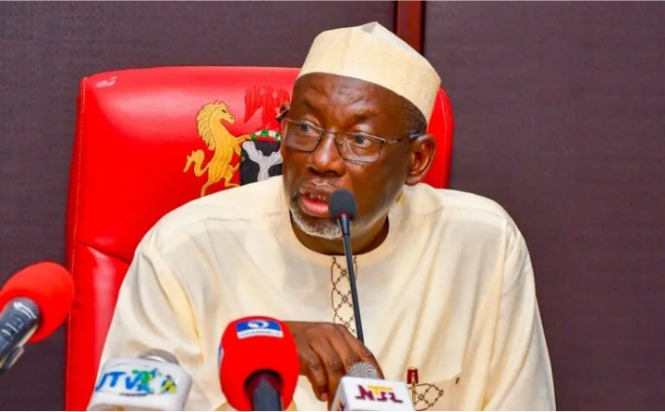
Gov Umar Namadi: No to traducers
By AbdulShakur Musa
In recent weeks, a wave of political commentary has sought to portray Governor Umar Namadi as embattled, presiding over a fractured party.
The allegations hinge largely on internal party disputes, defections, and supposed estrangement from key political figures such as former governor of Jigawa State and Minister of Defence, Mohammed Badaru Abubakar and Isa Gerawa.
Yet, a closer and more objective examination reveals a different story, of a governance anchored in responsibility, reform, and measurable progress.
It is important, first and foremost, to separate political noise from governance reality. Democracy, by its very nature, accommodates dissent, shifting alliances, and periodic realignments. What is being described as a “crisis” within the All Progressives Congress (APC) in Jigawa may, in fact, be a reflection of this democratic dynamism rather than evidence of systemic failure.
To reduce governance to the management of political egos or godfather relationships is to misunderstand the very essence of public service.
Governor Umar Namadi did not assume office as a proxy to any individual; he emerged through a legitimate democratic process, entrusted by the people of Jigawa State to lead with vision and integrity.
His administration has consistently demonstrated that governance must prioritise the welfare of citizens above the preservation of political patronage networks.
Critics have pointed to defections by certain political actors, including figures like Sabo Nakudu and Muhammad Ubali Shitu, as evidence of a weakening party structure. However, history has shown that political defections are rarely driven by altruistic concerns for governance; more often, they reflect personal ambitions, disagreements over influence, or recalculations ahead of future elections.
Jigawa’s political stability cannot and should not be judged solely by the movements of a few individuals.
More crucial is the performance of the government itself, and on this front, Gov Namadi’s record stands firm.
Since assuming office, the Namadi administration has prioritised economic empowerment, agricultural transformation, and infrastructural development. Building on Jigawa’s agrarian strengths, the government has expanded support for farmers through subsidised inputs, improved irrigation schemes, and access to modern farming techniques. These interventions are not mere policy statements; they have translated into increased productivity, enhanced food security, and improved livelihoods for thousands of households across the state.
In the area of education, Gov Namadi has taken decisive steps to address long-standing challenges. His administration has invested in school rehabilitation, teacher recruitment, and capacity building, ensuring that the quality of education begins to match the aspirations of the state’s youthful population. Rather than politicising the sector, he has focused on laying a sustainable foundation for future generations.
Healthcare delivery has also witnessed notable improvements. Primary healthcare centres are being revitalised, essential drugs made more accessible, and maternal and child health programmes strengthened. These efforts reflect a government that understands that development is measured not by rhetoric but by the well-being of its people.
Infrastructure development under Gov Namadi has been equally significant. Road construction and rehabilitation projects have enhanced connectivity between rural and urban areas, facilitating trade and easing movement. These projects are critical in a state where economic activity depends heavily on access to markets and services.
Equally commendable is the administration’s commitment to transparency and fiscal discipline. In this time when public trust in governance is often eroded by allegations of mismanagement, Namadi has maintained a reputation for prudence and accountability. This has enabled the state to execute projects without plunging into unsustainable debt, a hallmark of responsible leadership.
It is within this context that the current criticisms must be understood. When a leader chooses to prioritise public interest over entrenched political interests, resistance is inevitable. Those accustomed to influence without accountability may interpret reform as exclusion. Yet, governance is not about appeasing every stakeholder; it is about making decisions that serve the greater good of the masses.
The narrative of a “cold war” between Gov Namadi and his predecessor, Badaru Abubakar, remains largely speculative. Even if differences exist, as they often do in political transitions, they should not be exaggerated into a governance crisis.
Advanced democracies recognise that leadership evolves, and new administrations are entitled to chart their own course.
Furthermore, the assertion that grassroots structures are collapsing ignores the enduring support Gov Namadi enjoys among ordinary citizens. In markets, communities, and local gatherings across Jigawa, there is a palpable sense of approval for his people-centred policies.
Unlike political elites, the average citizen evaluates leadership based on tangible improvements in daily life, and by that standard, Namadi continues to earn popular trust.
It is also worth noting that political opposition, whether within or outside the ruling party, plays a legitimate role in democracy. However, criticism must be grounded in facts, not conjecture. Labelling governance reforms as marginalisation or attributing state matters to unverified personal rifts risks misleading the public and undermining constructive discourse.
Gov Umar Namadi’s leadership embodies a shift from personality-driven politics to performance-driven governance. His focus on agriculture, education, healthcare, infrastructure, and fiscal responsibility reflects a clear vision that laid the foundation for Jigawa’s development.
These are not the actions of a leader presiding over decline, but of one laying the groundwork for long-term prosperity.
In the final analysis, the true measure of leadership lies not in the absence of opposition but in the ability to deliver despite it. Gov Namadi has demonstrated resilience, clarity of purpose, and a commitment to the people of Jigawa State. The attempts to portray him otherwise are, at best, politically motivated narratives that fail to withstand objective scrutiny.
Indeed, far from being diminished by criticism, Gov Namadi continues to emerge as a statesman whose dedication to service, integrity, and progress makes him not only a pride of Jigawa but a model for governance in Nigeria.
AbdulShakur Musa writes from Wuse Zone 4, Abuja